Freshers’ Week(新生周), the initiation(入门仪式) into British university life, is often a blur of(一片模糊的记忆) cheap pints and sticky dance floors. For German-born Sophie Blank, it was an introduction to another British rite of passage(人生仪式、成人礼): getting on the property ladder(踏上购房阶梯). Her new classmates, barely out of school, were already plotting(盘算、谋划) their paths to homeownership(拥有住房), she says. Now 33, working in AI and content creation, and posting about money matters on social media, Ms Blank says she is “happily renting” in Notting Hill, in west London.(如今33岁的布兰克从事人工智能和内容创作,并在社交媒体上发布理财内容。她说自己在伦敦西区的诺丁山“快乐地租房住”。) She is putting her savings into stocks instead. The property ladder, she declares, can wait.
新生周是英国大学生活的入门仪式,往往在廉价的啤酒和黏糊糊的舞池中一晃而过。但对出生于德国的索菲·布兰克来说,它却让她见识了英国另一项人生仪式:踏上购房阶梯。她说,她的新同学刚出校门,就已经在盘算如何拥有自己的房子了。如今33岁的布兰克从事人工智能和内容创作,并在社交媒体上发布理财内容。她说自己在伦敦西区的诺丁山“快乐地租房住”,而是把积蓄投进了股票。她宣称,购房阶梯可以再等等。
In Germany people tend to rent their homes. But those in the Anglosphere(英语国家圈) buy if they can afford to(如果负担得起)—and have long built the bulk of(大部分) their wealth that way, encouraged by the post-war proliferation(激增、扩散) of policies to promote home-buying. In America and Canada, homeowners are wealthier than renters, a gap that has widened(扩大、拉大) over time. In Britain, estimates the Yorkshire Building Society, a lender, by retirement age homeowners are on average nearly £800,000 ($1.1m) richer than renters, with property accounting for almost half the gap.(英国贷款机构约克郡建房互助协会估计,到退休年龄时,有房者平均比租房者富有近80万英镑(约110万美元),其中房产贡献了差距的近一半。) In Australia around one in seven(七分之一) taxpayers owns an investment property.
在德国,人们倾向于租房住。但英语国家的人只要负担得起就会买房,并长期以此积累大部分财富,这得益于战后大量鼓励购房的政策。在美国和加拿大,有房者比租房者更富有,而且这一差距随时间不断扩大。英国贷款机构约克郡建房互助协会估计,到退休年龄时,有房者平均比租房者富有近80万英镑(约110万美元),其中房产贡献了差距的近一半。在澳大利亚,大约每七个纳税人中就有一人拥有投资性房产。
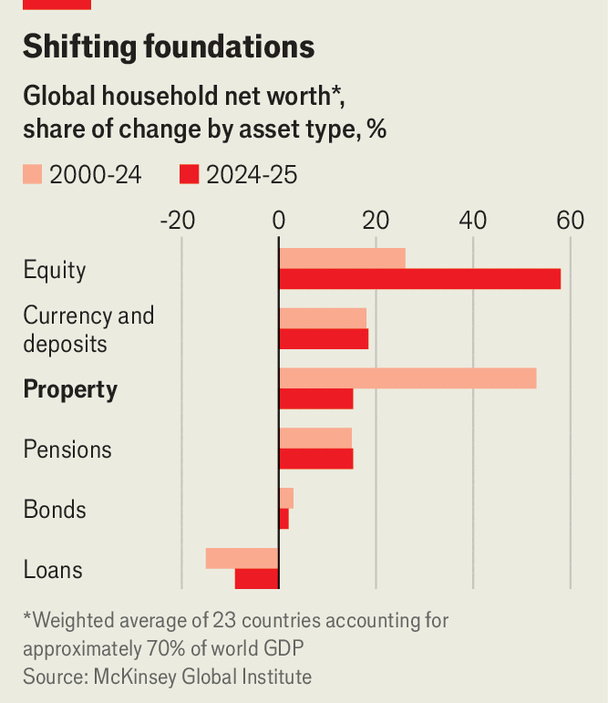
Now it seems less clear that property is the path to wealth, especially for the young. Although housing markets in many countries have softened(走弱、降温) lately, they are still close to all-time highs(历史最高点) after adjusting for inflation(经通胀调整), according to The Economist’s latest estimates. For many, getting on the housing ladder is too costly to contemplate(考虑、设想): in Ireland three-fifths of 18- to 34-year-olds live with their parents. But property is also looking less attractive as an investment. As higher interest rates cool house prices, households are generating more of their wealth from stocks than from property, reversing(逆转、扭转) a two-decade trend. Of the $40trn added to global household wealth in 2025, 57% came from stocks and 15% from property—a marked contrast with the previous 25 years, in which property’s share averaged 52% and that of equities 26%, according to the McKinsey Global Institute (MGI), a think-tank within a consultancy (see chart).(据咨询公司旗下的智库麦肯锡全球研究院统计,2025年全球家庭财富新增40万亿美元,其中57%来自股票,15%来自房产——这与过去25年形成鲜明对比,那时房产平均占52%,股票占26%。)
如今,房产是否仍是通往财富之路,似乎已不那么明确,对年轻人尤其如此。尽管许多国家的房地产市场近期有所降温,但据《经济学人》最新估算,经通胀调整后,房价仍接近历史高点。对许多人来说,踏上购房阶梯的成本高得难以想象:在爱尔兰,18至34岁人群中有五分之三与父母同住。但房产作为投资品的吸引力也在下降。随着利率上升压低房价,家庭财富中来自股票的部分已超过来自房产的部分,逆转了持续二十年的趋势。据咨询公司旗下的智库麦肯锡全球研究院统计,2025年全球家庭财富新增40万亿美元,其中57%来自股票,15%来自房产——这与过去25年形成鲜明对比,那时房产平均占52%,股票占26%(见图表)。