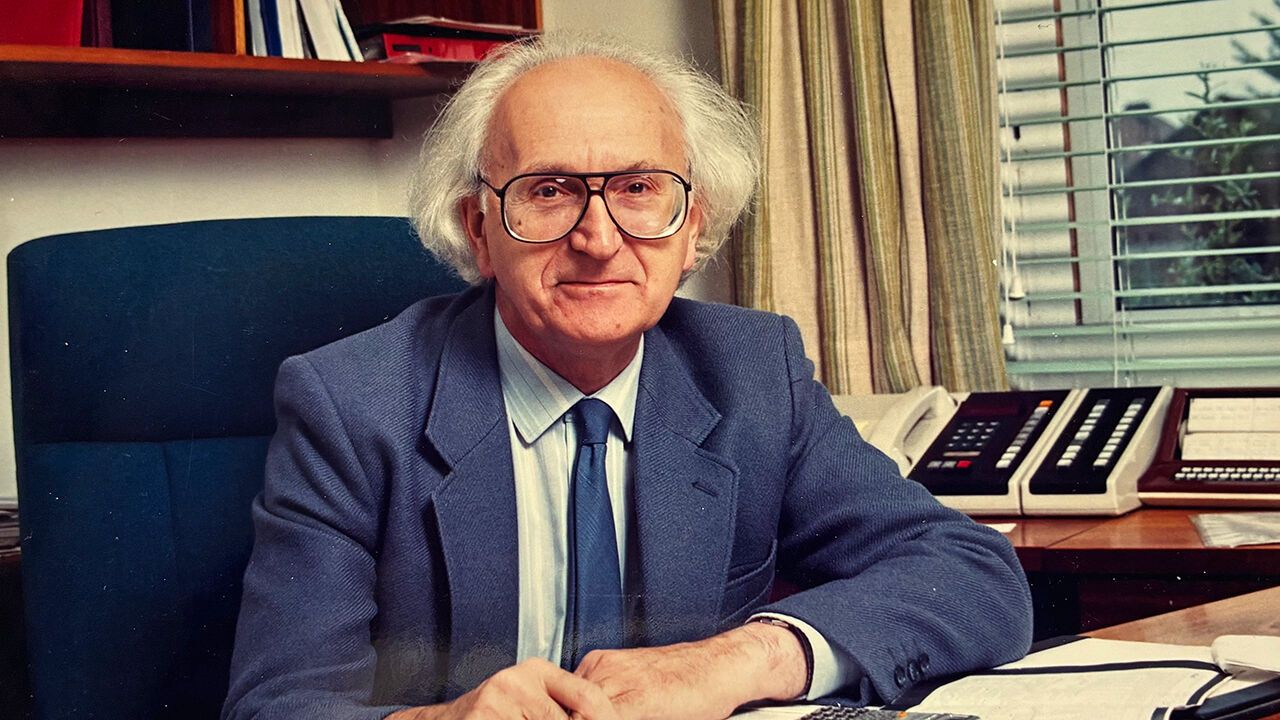
Whenever in later life a fresh idea struck him, Cyril Hilsum would leave the dinner table and wander to his lab. He didn’t have far to go. Part of it was in the garage, part in the scullery(洗涤间,后厨), of his house in Pinner, north-west of London. The rest was in the kitchen. One counter was his electronics bench, with an oscilloscope, a pair of waveform generators, a spectrum analyser and a tray of voltage dividers looped to each other and to a soldering station with a maze of cables.(一个台面是他的电子工作台,上面摆着示波器、一对波形发生器、一台频谱分析仪,还有一盘分压器,彼此用迷宫般的线缆连接,又接到一个焊接台上。) On the facing counter stood a three-roll mill(三辊研磨机) for working conductive powders, a precision balance, a small vacuum chamber and many labelled jars of carbon black(炭黑) and nickel powder. Everything had its place here apart from kitchen stuff; but he dined, and lunched too, mostly on red wine, ready meals and chocolate. Fruit and veg he disdain(鄙视,不屑)ed. He lived very healthily on a diet of curiosity, hard work and endless ideas.
晚年时,每当灵光一闪,西里尔·希尔萨姆就会离开餐桌,溜达进他的实验室。他不用走多远。实验室一部分在车库里,一部分在洗涤间里——那是他位于伦敦西北平纳的家。其余部分则在厨房。一个台面是他的电子工作台,上面摆着示波器、一对波形发生器、一台频谱分析仪,还有一盘分压器,彼此用迷宫般的线缆连接,又接到一个焊接台上。对面的台面上立着一台用于研磨导电粉末的三辊研磨机、一台精密天平、一个小型真空腔,以及许多贴了标签的罐子,里面装着炭黑和镍粉。这里除了厨房用品,每样东西都有自己的位置;但他吃饭,午饭也是,主要靠红酒、即食餐和巧克力。水果蔬菜他瞧不上。他靠好奇心、勤奋和无穷无尽的想法,活得非常健康。
In all he had over 70 patent(专利)s to his name(归他所有,名下). The last, filed when he was 97, was for ink with sensors that conducted electricity. His lasting fame, though, came from liquid-crystal display(液晶显示器)s. In the 1970s he realised that these could replace the bulky, power-hungry TVs of old, with their bulging cathode-ray tubes and curved screens, with slim flat-screen models that could be hung on a wall.(20世纪70年代,他意识到液晶显示器可以取代旧式笨重、耗电的电视——那些有着鼓鼓的阴极射线管和弧形屏幕的电视——用可以挂在墙上的纤薄平板型号取而代之。) He and his collaborators started small, with digital watches in 1974; but in no time(转眼间,立刻) flat screens were everywhere, in computer monitors, cockpit(驾驶舱) displays, departure board(出发信息板)s and, especially, mobile phones. Sharper images took longer; but in the modern screen-bound(被屏幕包围的) age, he changed the world’s way of seeing.
他一生拥有70多项专利。最后一项是在他97岁时提交的,关于一种带传感器的导电墨水。不过,他持久的声名来自液晶显示器。20世纪70年代,他意识到液晶显示器可以取代旧式笨重、耗电的电视——那些有着鼓鼓的阴极射线管和弧形屏幕的电视——用可以挂在墙上的纤薄平板型号取而代之。他和合作者从小处着手,1974年先用于数字手表;但转眼间,平板屏幕无处不在,出现在电脑显示器、驾驶舱显示屏、出发信息板上,尤其是手机上。更清晰的图像花了更长时间;但在如今这个被屏幕包围的时代,他改变了世界观看的方式。
It had been difficult work. Liquid crystals certainly behaved like liquids, because they flowed, but their molecules could keep a structure for a very brief time.(液晶确实表现得像液体,因为它们会流动,但它们的分子只能在极短的时间内保持结构。) It was up to him to(由他来决定/负责) stabilise(使稳定) them and induce(诱导,引起) them to work at room temperature. In two years he and two colleagues, George Gray and Peter Raynes, produced and patented a whole new controllable(可控的) family of them.
这项工作很艰难。液晶确实表现得像液体,因为它们会流动,但它们的分子只能在极短的时间内保持结构。稳定它们并诱导它们在室温下工作,就靠他了。两年内,他和两位同事乔治·格雷和彼得·雷恩斯制造并申请了一整类全新的可控液晶的专利。