The world’s richest man does not much believe in philanthropy(慈善事业). In August Elon Musk said in a social-media post that Brian Armstrong, a crypto boss, was right to dismiss many charities as “net negative(净负面)” for the world. Weeks earlier he had joined attacks on Mackenzie Scott, the ex-wife of Jeff Bezos, Amazon’s founder, and one of the biggest donors in history, for “making the world a worse place”. Mr Musk’s distaste for do-goodery(行善行为) is not new. He led the near-demolition(近乎摧毁) of America’s aid agency, and was once quoted describing philanthropy as “bullshit”. In Mr Musk’s reckoning(看法,计算), his gift to humanity is his for-profit work(营利性工作): the electric vehicles he produces at Tesla, the space exploration he is doing at SpaceX and the political debate on his social-media site, X.
这位世界首富并不太相信慈善。今年8月,埃隆·马斯克在社交媒体上发帖称,加密货币老板布莱恩·阿姆斯特朗将许多慈善机构斥为对世界“净负面”是正确的。几周前,他还加入了对麦肯齐·斯科特的攻击,称其“让世界变得更糟”。斯科特是亚马逊创始人杰夫·贝索斯的前妻,也是历史上最大的捐赠者之一。马斯克对行善的厌恶并非新鲜事。他主导了对美国援助机构的近乎解散,还曾被引述称慈善是“胡扯”。在马斯克看来,他对人类的贡献是他的营利性工作:特斯拉生产的电动汽车、SpaceX正在进行的太空探索,以及他的社交媒体网站X上的政治辩论。
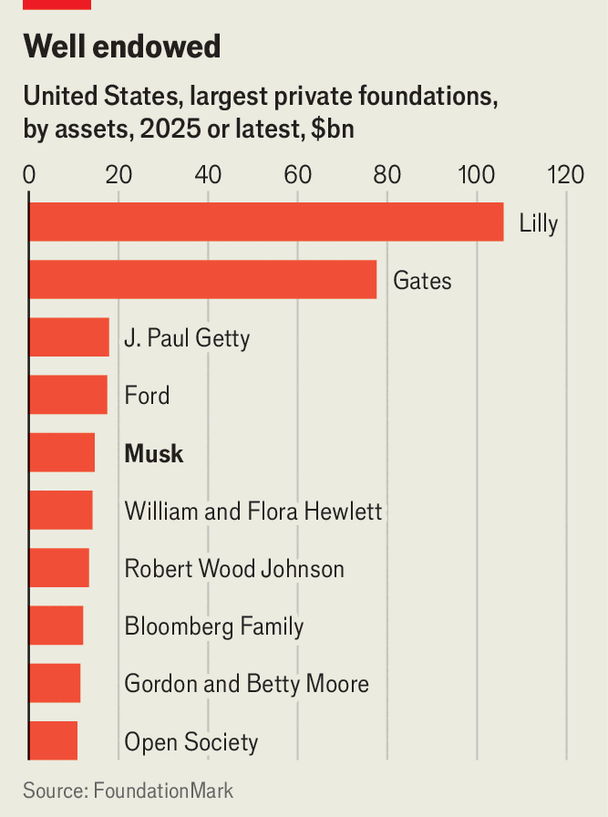
And yet Mr Musk also runs America’s fifth-largest charitable private foundation(慈善私人基金会). With $14.7bn in assets at last count, the Musk Foundation is a hair smaller(略小一点) than the Ford Foundation and more than double the size of the Rockefeller Foundation, two long-standing pillars(支柱) of philanthropy (see chart). Unlike these organisations, however, the Musk Foundation says almost nothing about its work. Its website contains a mere 33 words, laying out the causes it supports, which include renewable energy, space exploration and artificial-intelligence safety. And it is run by a team of just three: Mr Musk; the head of his family office, Jared Birchall; and Matilda Simon, another family-office employee. The only clues to the foundation’s activities are contained in tax returns. The Economist scoured(仔细搜索) the filings covering the period from July 2020 to the end of 2024 to find out: how does the tycoon(大亨) who detests(厌恶) philanthropy give?
然而,马斯克还经营着美国第五大慈善私人基金会。根据最新统计,马斯克基金会拥有147亿美元资产,比福特基金会略小,是洛克菲勒基金会规模的两倍多——这两个基金会都是慈善界长期以来的支柱(见图表)。然而,与这些组织不同,马斯克基金会几乎不公开其工作内容。其网站仅有33个词,列出了它支持的领域,包括可再生能源、太空探索和人工智能安全。基金会仅由三人团队运营:马斯克本人、他的家族办公室负责人贾里德·伯查尔,以及另一位家族办公室员工玛蒂尔达·西蒙。基金会活动的唯一线索藏在税务申报表中。《经济学人》仔细查阅了2020年7月至2024年底的申报文件,试图弄清:这位厌恶慈善的大亨究竟如何捐赠?
The first observation is that Mr Musk, like most very rich people, appears to craft(精心设计) his philanthropy to minimise his taxes. His biggest gifts—a total of around $8bn in Tesla stock—went to his foundation in 2021 and 2022, years when he came into(获得,继承) many billions of dollars of shares and faced a whopping(巨大的) tax bill as a result. Brian Mittendorf, an accounting expert at Ohio State University, says founders enjoy a “double benefit” from such donations: they avoid paying capital-gains tax on the shares, which originally cost them relatively little, and can then claim a charitable deduction based on the (far higher) market value.(俄亥俄州立大学会计专家布莱恩·米滕多夫表示,创始人从这类捐赠中享受“双重好处”:他们避免了为这些股票支付资本利得税(这些股票最初成本相对较低),然后还可以根据(高得多的)市场价值申请慈善抵扣。) At the end of 2024, the book value(账面价值) of the stock held by the Musk Foundation was around $5.7m, whereas their market value was an estimated $14bn.
第一个观察是,马斯克和大多数超级富豪一样,似乎精心设计自己的慈善行为以尽量减少税收。他最大的捐赠——总计约80亿美元的特斯拉股票——在2021年和2022年流入他的基金会,那两年他获得了数十亿美元的股票,并因此面临巨额税单。俄亥俄州立大学会计专家布莱恩·米滕多夫表示,创始人从这类捐赠中享受“双重好处”:他们避免了为这些股票支付资本利得税(这些股票最初成本相对较低),然后还可以根据(高得多的)市场价值申请慈善抵扣。2024年底,马斯克基金会持有的股票账面价值约为570万美元,而市场价值估计为140亿美元。
Cold as charity
冷若慈善