For more than four decades the semiconductor(半导体) industry has been governed by two laws as dependable as any in physics. The first is that the number of transistor(晶体管)s, the tiny switches etched onto a chip, keeps rising. The second is that every boom ends in a bust(每轮繁荣都以崩盘告终). The first, which makes chips more powerful, is in rude health.(第一条定律让芯片更加强大,如今正生机勃勃。) Leading processors for artificial intelligence contain more than 200bn transistors, and the industry reckons it can cram(塞入,挤入) in a trillion by the end of the decade. The second is stir(激起,引发)ring unease(不安,忧虑) about how long the good times will last.
四十多年来,半导体行业一直受两条定律支配,其可靠性堪比物理学中的任何定律。第一条是,晶体管——蚀刻在芯片上的微型开关——的数量持续增长。第二条是,每一轮繁荣都以崩盘告终。第一条定律让芯片更加强大,如今正生机勃勃。领先的人工智能处理器包含超过2000亿个晶体管,业界估计到本十年末可以塞进一万亿个。第二条定律则让人不安:好日子还能持续多久?
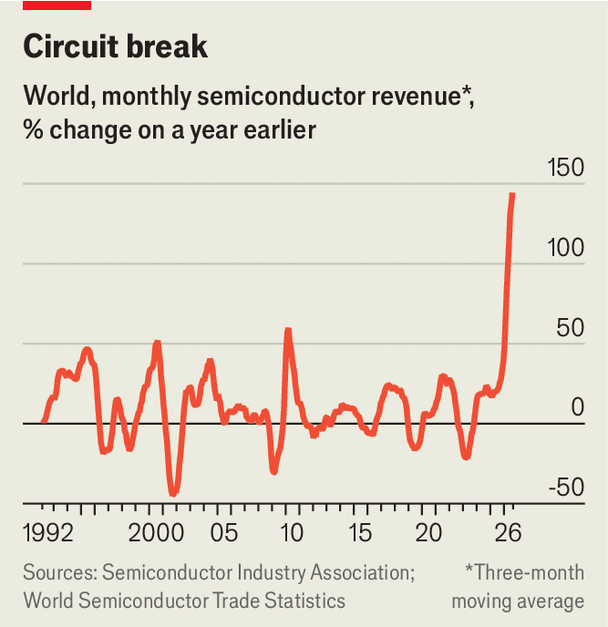
The industry is used to booms, but not one like this. AI has created an insatiable(永不满足的) appetite for the chips used to train and run AI models. In the first half of 2026 semiconductor sales grew faster, year on year(同比,与去年同期相比), than at any time since the 1980s (see chart). This month TSMC, the world’s biggest contract chipmaker, reported its sixth consecutive(连续的) quarter of record profits; Samsung Electronics, a South Korean chip heavyweight, reported its fourth. Yet investors are growing jittery(紧张不安的). Despite blowout(大获成功的,压倒性的) results and rosy forecasts(乐观的预测), an index of leading semiconductor firms has fallen by over 10% since October 6th. Their fears were not helped when on October 12th Hock Tan, boss of Broadcom, a big chip designer, likened many investors in the AI trade to gamblers in a casino who “have no clue” what they are investing in.(10月12日,大型芯片设计公司博通老板陈福阳将许多AI交易投资者比作赌场里的赌徒,说他们"根本不知道"自己在投资什么,这更是雪上加霜。)
这个行业对繁荣并不陌生,但从未见过这样的繁荣。人工智能对用于训练和运行AI模型的芯片产生了永不满足的需求。2026年上半年,半导体销售额的同比增长速度创下1980年代以来的最高纪录(见图表)。本月,全球最大的代工芯片制造商台积电公布了连续第六个季度的创纪录利润;韩国芯片巨头三星电子则公布了连续第四个。然而,投资者却日益紧张。尽管业绩亮眼、前景乐观,但自10月6日以来,领先半导体企业的指数已下跌超过10%。10月12日,大型芯片设计公司博通老板陈福阳将许多AI交易投资者比作赌场里的赌徒,说他们"根本不知道"自己在投资什么,这更是雪上加霜。
Nearly all of the industry’s expected growth hinges on chips for AI, making it a giant bet on the technology. If that bet sours—and the “supercycle”, as some have taken to calling it, comes to an end—will chipmakers suffer a bust as vertiginous as the boom?(如果这场赌注变味——被一些人称为"超级周期"的繁荣走向终结——芯片制造商是否会遭遇与繁荣同样令人眩晕的崩盘?) There are reasons to think not.
该行业几乎所有预期增长都取决于AI芯片,这使它成为对这项技术的一场巨大赌注。如果这场赌注变味——被一些人称为"超级周期"的繁荣走向终结——芯片制造商是否会遭遇与繁荣同样令人眩晕的崩盘?有理由认为不会。