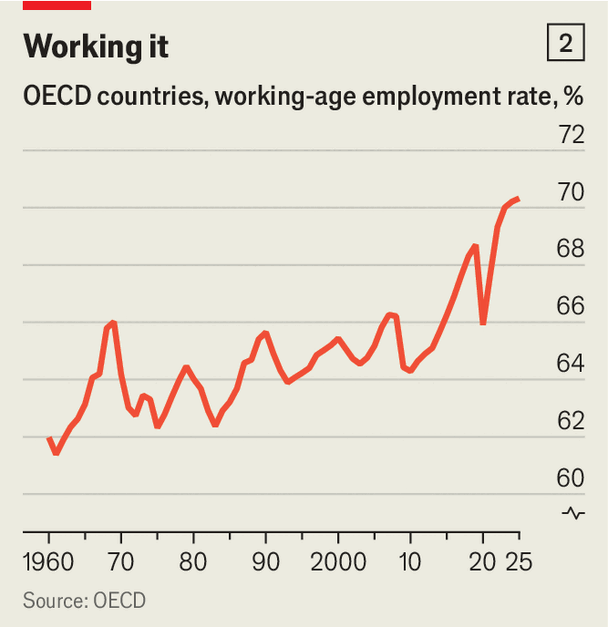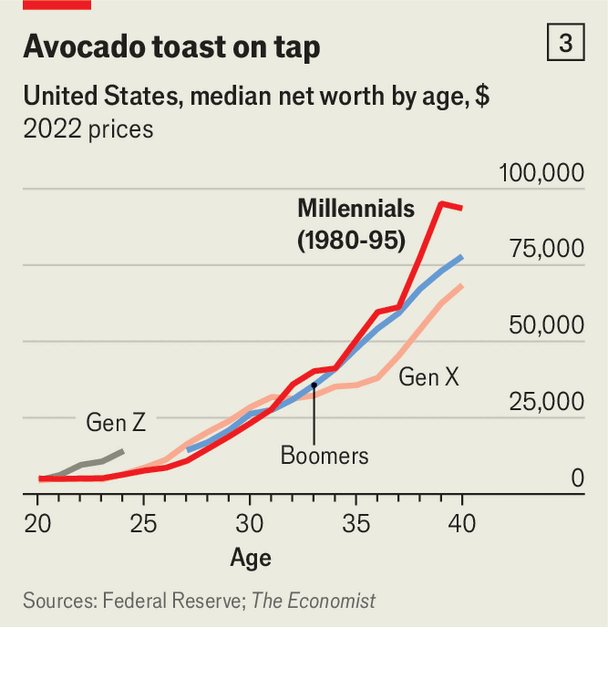
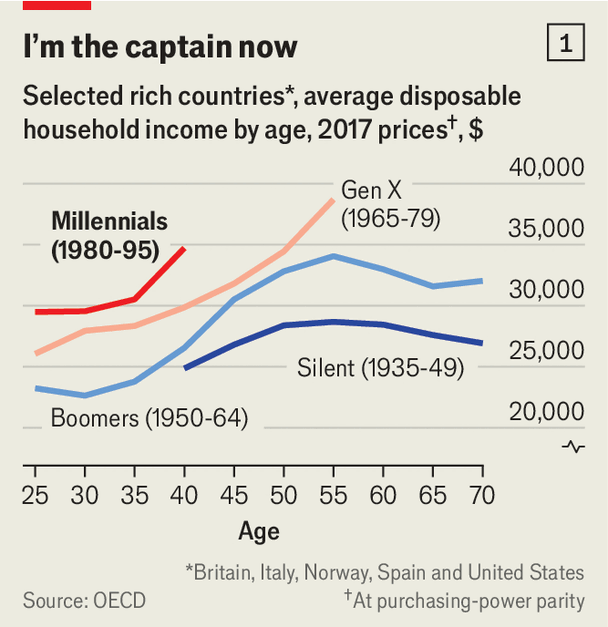
SOME OF THE clichés(陈词滥调) about millennials are still true. In America that generation, now aged between their early 30s and mid-40s, may last year have spent around $1.5bn on avocados, according to The Economist’s rough estimate. Millennials also really do buy more craft beer than other cohorts(同龄群体). But, across rich countries, an even more enduring stereotype about millennials has stopped fitting the facts(符合事实). They are no longer struggling as they once did. Many are out-earning(收入超过) their parents (see chart 1). Growing numbers occupy positions of real power in business, politics and culture. Home-ownership(住房拥有率) is rising fast.
关于千禧一代的一些老生常谈仍然没错。在美国,这一代人如今大约三十出头到四十五岁上下,据《经济学人》粗略估算,他们去年可能在牛油果上花了约15亿美元。千禧一代确实也比其他年龄群体买了更多精酿啤酒。但在富裕国家,一个更根深蒂固的刻板印象已经不再符合事实:他们不再像从前那样苦苦挣扎。许多人收入已超过父母(见图表1)。越来越多的人在商业、政治和文化领域占据实权位置。住房拥有率正在快速上升。
This represents a sharp reversal(逆转) from the 2010s, when millennials went through their 20s. During the worst of Greece’s economic crisis, youth unemployment was above 50%. Wages of Britons of that age were not really growing. About 40% of their German peers lived with their parents. Social movements, from UK Uncut and Spanish indignados to America’s Occupy Wall Street(占领华尔街运动), which were spearheaded(带头,率先发起) by millennials, hinted at the level of disenchantment(幻灭,失望) with the status quo(现状). So did widespread support for elderly left-wingers such as Jeremy Corbyn, Jean-Luc Mélenchon and Bernie Sanders(三位年迈左翼政治家).
这与2010年代形成鲜明反差,当时千禧一代正经历二十多岁。在希腊经济危机最严重时,青年失业率超过50%。英国同龄人的工资几乎不增长。约40%的德国同龄人还与父母同住。由千禧一代带头的社会运动——从英国的“UK Uncut”、西班牙的“愤怒者”到美国的“占领华尔街”——暗示了他们对现状的幻灭程度。他们对杰里米·科尔宾、让-吕克·梅朗雄和伯尼·桑德斯等年迈左翼人士的广泛支持也说明了这一点。
Many millennials would still vote for these socialist old-timers(老资格,老前辈). But it is increasingly not in their economic interest(符合他们的经济利益) to do so. The Economist has assembled(收集,汇总) data on millennials’ incomes for 32 rich countries. In just three—Italy, Greece and Japan—are millennials worse off, in terms of inflation-adjusted income, than previous generations at the same age.(只有三个国家——意大利、希腊和日本——千禧一代经通胀调整后的收入低于前几代人在同年龄时的水平。) At 30, Italian ones earned 10% less than Gen-Xers (born roughly between 1965 and 1979) at that age. Their Greek peers are still behind the young adults of the 2000s, before Greece suffered a crippling(严重的,毁灭性的) economic crisis starting in 2009. In Japan, the third exception, a 35-year-old’s household earnings in 2019 were below those of a 35-year-old in 1994, shortly after a giant bubble popped, deflating(使通缩,使泄气) the economy for decades.
许多千禧一代仍会投票给这些社会主义老将。但这样做越来越不符合他们的经济利益。《经济学人》汇总了32个富裕国家千禧一代的收入数据。只有三个国家——意大利、希腊和日本——千禧一代经通胀调整后的收入低于前几代人在同年龄时的水平。30岁的意大利千禧一代收入比同龄X世代(约生于1965至1979年)低10%。他们的希腊同龄人仍落后于2000年代的年轻人,当时希腊尚未在2009年陷入严重经济危机。第三个例外是日本:2019年35岁人群的家庭收入低于1994年35岁人群,当时巨大泡沫刚刚破裂,经济陷入数十年通缩。