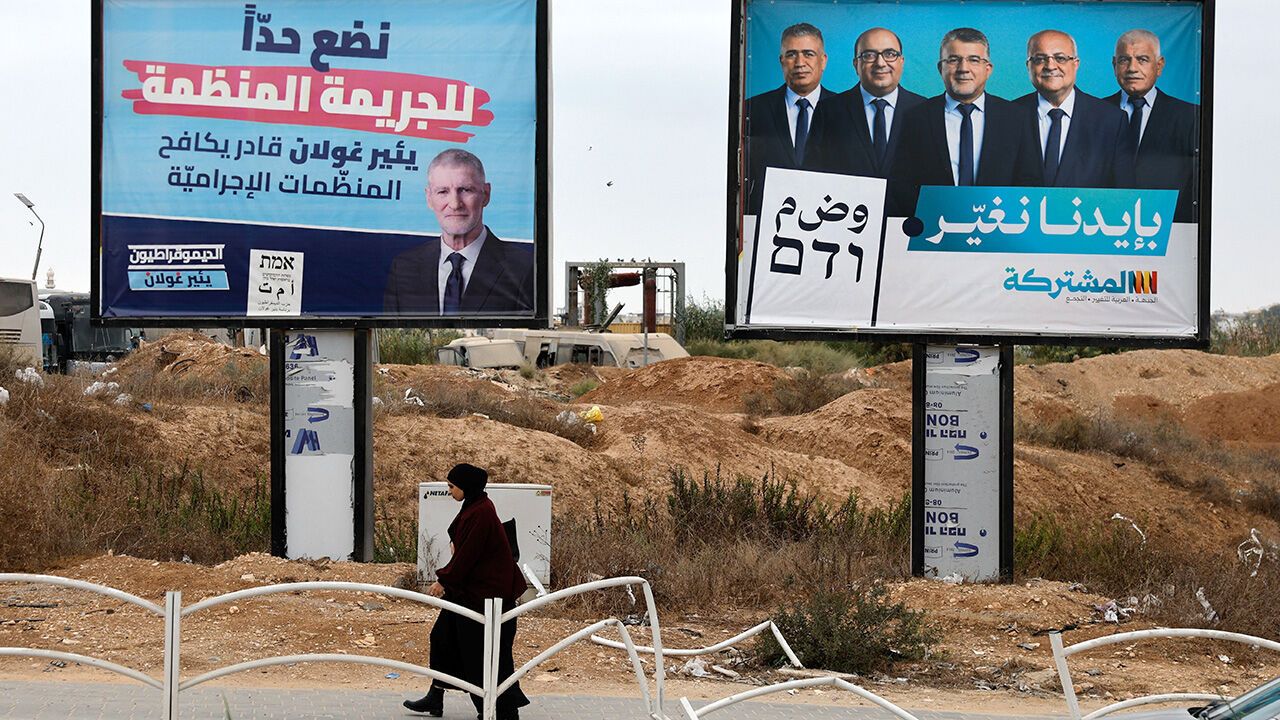
In A campaign video released on October 10th Yousef Jabareen, leader of the Joint List, a slate(候选人名单) of candidates from three predominantly Arab-Israeli parties, made a striking announcement. The bloc would "use all the tools" at its disposal(可供其支配) to replace the government and "serve as a safety net(充当安全网)" for the opposition. For most of Israel's history, they have stayed on the sidelines(置身事外), in opposition. But this year, for the first time in an Israeli election, all the parties representing Israel's Palestinian citizens have vowed(誓言、郑重承诺) to try to change the government.
10月10日发布的一段竞选视频中,联合名单领导人优素福·贾巴林发表了一项引人注目的声明。联合名单是由三个以阿拉伯裔以色列人为主的政党组成的候选人联盟。该联盟将“动用一切手段”来替换政府,并为反对派“充当安全网”。在以色列历史上大部分时间里,他们一直置身事外,处于反对派位置。但今年,在以色列选举中,代表以色列巴勒斯坦公民的所有政党首次誓言要尝试改变政府。
"This is an existential(关乎存亡的) election for Jews and Arabs," says Ahmed Tibi, head of the Arab Movement for Change, one of the parties in the Joint List. "The levels of racism and incitement(煽动、鼓动) from this fascist(法西斯的) government are simply too great. We'll do almost anything to kick them out(把他们赶下台)." This should mean Binyamin Netanyahu and his allies can be beaten. The Economist's poll tracker has his opponents, Jewish and Arab, together averaging 64 seats in the 120-seat Knesset, Israel's parliament.(《经济学人》的民调追踪显示,他的反对者——犹太人和阿拉伯人合计——在拥有120个席位的以色列议会中平均可获得64席。) And yet the Arab parties remain unwelcome.
“对犹太人和阿拉伯人来说,这是一场关乎存亡的选举,”联合名单成员党之一“阿拉伯变革运动”的领导人艾哈迈德·蒂比说。“这个法西斯政府的种族主义和煽动程度实在太过分了。为了把他们赶下台,我们几乎什么都愿意做。”这理应意味着本雅明·内塔尼亚胡及其盟友可以被击败。《经济学人》的民调追踪显示,他的反对者——犹太人和阿拉伯人合计——在拥有120个席位的以色列议会中平均可获得64席。然而,阿拉伯政党仍然不受欢迎。
For decades the parties representing Arab voters, who make up around 20% of the electorate(全体选民), stayed outside the post-election coalition wrangling(组阁博弈). But since the 1980s they have endorsed(公开支持、背书) candidates for prime minister and in 1992, they formed a de facto(事实上的) bloc with centre-left parties to prevent the right-wing Likud party from forming a coalition. In 2021 Ra'am, a small conservative-Islamist party broke away(脱离、分裂出去) from the Joint List, insisting it wanted to go further, and that it would join any government in which it could have some influence on behalf of(代表、为了……利益) Arab voters.
几十年来,代表阿拉伯选民的政党一直置身于选后组阁博弈之外,阿拉伯选民约占选民总数的20%。但自20世纪80年代以来,他们一直为总理候选人背书;1992年,他们与中左翼政党组成事实上的联盟,阻止右翼利库德党组阁。2021年,小型保守伊斯兰主义政党拉阿姆脱离联合名单,坚称自己想走得更远,并表示愿意加入任何能代表阿拉伯选民施加一定影响的政府。