
THE STEREOTYPE of a scientist is someone who wears a white coat and toil(埋头苦干)s in a laboratory, doing experiments with test tubes. In reality, researchers spend a surprising amount of time doing(花在……上的时间多得惊人) paperwork: writing grant(科研经费;拨款) applications, drafting and reviewing scientific papers, and reading new results in journals. If there is one thing that modern artificial-intelligence systems are good at handling, however, it is language.(然而,如果说现代人工智能系统有什么拿手好戏,那就是处理语言。) So could AI make scientists more productive by handling some of these tasks, freeing them to spend more time on actual research? That is possible. But AI has also made it easier to produce low-quality and even fraudulent(造假的;欺诈的) science, which is overwhelming systems of moderation and peer review. Which trend will win out(最终胜出)?
人们印象中的科学家,总是身穿白大褂、在实验室里埋头苦干,用试管做实验。可现实中,研究人员花在文书工作上的时间多得惊人:撰写经费申请、起草和评审论文、阅读期刊上的新成果。然而,如果说现代人工智能系统有什么拿手好戏,那便是处理语言。那么,AI能否接手其中一些任务,让科学家提高效率,腾出更多时间做真正的研究?这并非不可能。但AI也让炮制低质甚至造假科研成果变得更容易,正让审核与同行评审体系不堪重负。哪一股趋势会占上风?
A survey of Australian scientists found that they spent between one and three months a year, or 16% of their time on average, preparing research proposal(计划书;申请方案)s. Other studies have shown that a typical grant application takes around 34 days of work to prepare, and the success rate is only around 20%. So it is hardly surprising that(……也就不足为奇了) around a quarter of researchers are using AI tools to speed up the process, according to a survey published in April by Elsevier(爱思唯尔,全球最大的科学期刊出版商之一), a publisher of scientific journals. James Wilsdon, who studies research policy at University College London, gives the example of a researcher he spoke to at an Ivy League(常春藤盟校,美国东北部八所顶尖私立大学) university. Having previously spent one day a week writing grant proposals, the researcher now spends 45 minutes, thanks to AI.(这位研究者过去每周要花一天写经费申请,如今借助AI只需45分钟。) "The extra capacity that is being unlocked by all of this is immense(巨大的)," says Dr Wilsdon.
一项针对澳大利亚科学家的调查发现,他们每年要花一到三个月、平均16%的时间来撰写研究计划书。其他研究显示,一份典型的经费申请大约需要34个工作日来准备,而成功率只有20%左右。因此,根据科学期刊出版商爱思唯尔今年4月发布的一项调查,约四分之一的科研人员正在使用AI工具来加速这一流程,也就不足为奇了。伦敦大学学院研究科研政策的詹姆斯·威尔士登举了一个例子:他在一所常春藤盟校交谈过的一位研究者,过去每周要花一天写经费申请,如今借助AI只需45分钟。威尔士登博士说:"这一切所释放出的额外产能是巨大的。"
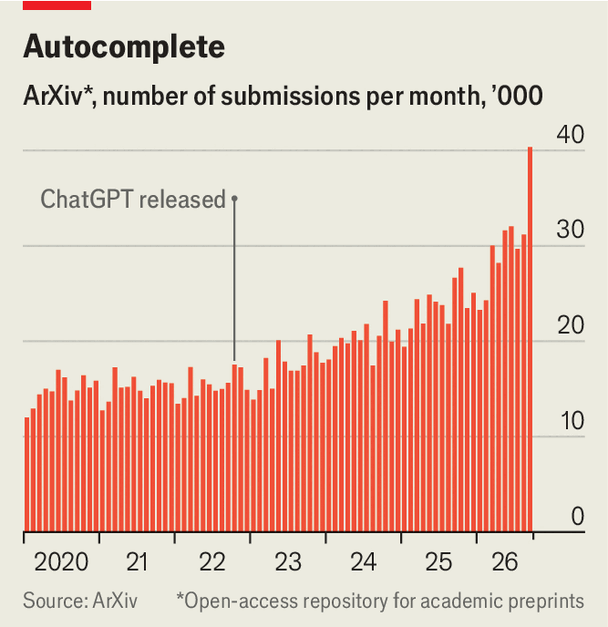
A similar transformation is under way(正在进行中) at a later stage of the scientific process: the drafting of papers describing research outcomes, and their vet(审查;审核)ting by peers for inclusion in scientific journals. As with grant proposals, the use of AI tools has made papers easier to write. Since the launch of ChatGPT in 2022 submissions to journals in the Science family and uploads to arXiv, the world's largest preprint server, have grown (see chart).(自2022年ChatGPT问世以来,投向《科学》系列期刊的稿件以及上传至全球最大预印本服务器arXiv的论文数量都在增长。) Fields like computer science, which rely less on experiments and lab work, have seen the biggest increases. From 2025 to 2026, paper submissions to the International Conference on Machine Learning (ICML(机器学习国际会议,AI领域三大顶会之一)) doubled to 24,000.
在科研流程的后期阶段——撰写描述研究成果的论文,以及由同行评审以决定能否在科学期刊上发表——类似的变革也在发生。与经费申请一样,AI工具的使用让论文更容易写出来。自2022年ChatGPT问世以来,投向《科学》系列期刊的稿件以及上传至全球最大预印本服务器arXiv的论文数量都在增长(见图表)。计算机科学等较少依赖实验和实验室工作的领域,增幅最大。2025年至2026年,机器学习国际会议(ICML)收到的论文投稿翻了一番,达到2.4万篇。
Questionable results
存疑的结果