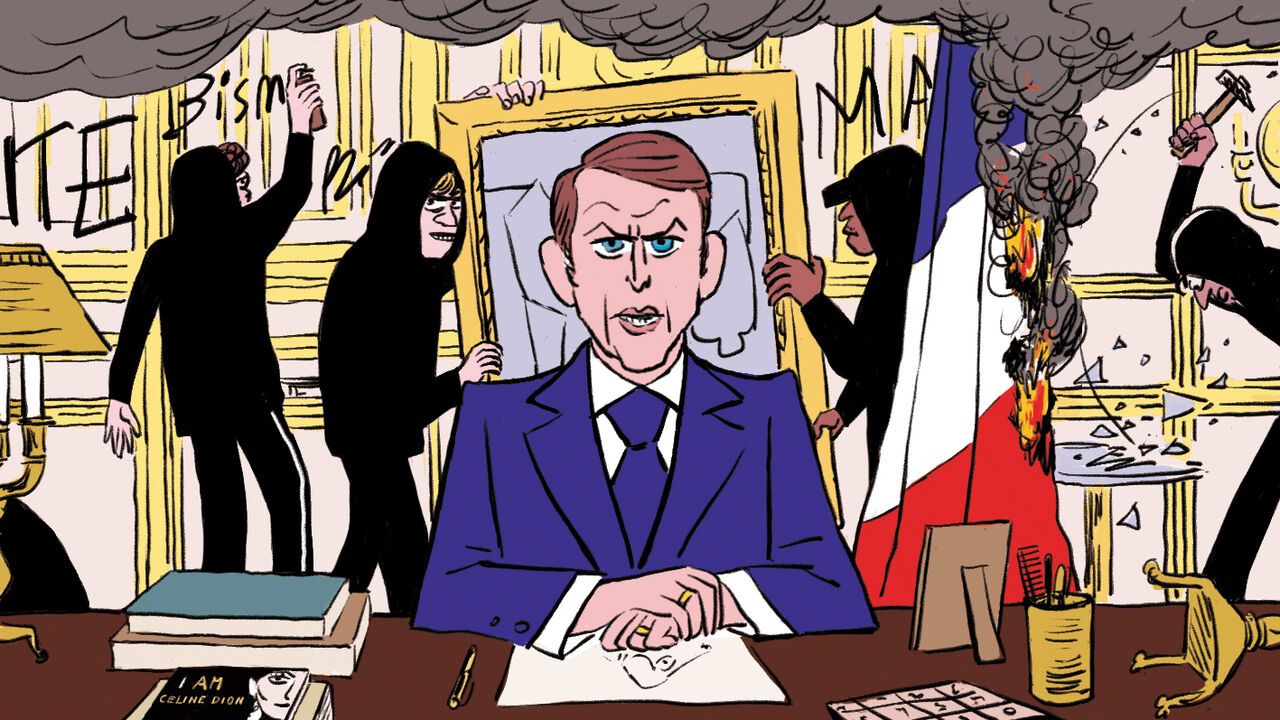
There are better ways to vaunt(炫耀,吹嘘) the merits of your economic model than setting fire to your capital. But tell that to the French. In recent years protests have become such a fixture of national life it is hard to see when one set of manifestations ends and the next begins.(近年来,抗议已成为国民生活的固定节目,让人分不清一场游行何时结束、下一场何时开始。) Everyone from students to pensioners seems to walk about in a perennial huff(常年怒气冲冲). The political class is at war with itself, wondering if an unloved president will soon make way for(让位给) a populist rabble-rouser(煽动民众的政客). Bond vigilantes are giving a bloody nose to(给……一点颜色看看) the over-indebted(负债过重的) government in Paris, demanding ever-higher yields to finance its runaway(失控的) budgets. The recent spate of violence gives the impression of a state at once bloated(臃肿的) and overmatched(力不从心的). As always, the situation looks somewhat less dire from inside France than it does to outsiders. Still, who would want to emulate the policies of a place that seems so firmly on the skids(走下坡路)?
想炫耀自己经济模式的优越性,有比放火烧首都更好的办法。但这话跟法国人说去。近年来,抗议已成为法国国民生活的固定节目,一场游行还没结束,下一场就已开始,让人分不清界限。从学生到退休老人,似乎人人都常年憋着一肚子火。政界内斗不休,都在琢磨那位不受欢迎的总统会不会很快给一个民粹煽动家让位。债券义警正在给债台高筑的巴黎政府一点颜色看看,要求更高的收益率来为其失控的预算融资。最近一连串的暴力事件给人的印象是:这个国家既臃肿不堪,又力不从心。一如既往,从法国国内看,情况没有外人看到的那么糟糕。尽管如此,谁又会想效仿一个显然正在走下坡路的地方的政策呢?
Moi! Moi! Moi!(“我!我!我!”——讽刺法国以自我为中心) is the refrain(反复说的话) from France’s neighbours in the European Union. For even as Paris reeks of tear gas, ideas promoted by French officialdom(官场,官僚) for decades have become ascendant(占优势的) in EU circles. Particularly on economic matters, French thinking is being copy-pasted into statute books(被复制粘贴进法令全书) in Brussels. France may be running out of(耗尽) money, political stability and public patience; it is not running out of influence. A country that plenty think ought to serve as a cautionary tale(反面教材) is instead being treated as a blueprint(蓝图,模板). Call it the paradox of Parisian power: even as French politicians lose the ability to govern at home, they are tightening their ideological grip on Europe.(不妨称之为巴黎权力的悖论:法国政客在国内失去治理能力的同时,却在收紧对欧洲的意识形态掌控。)
“我!我!我!”这是法国在欧盟的邻国们反复念叨的调子。因为即便巴黎弥漫着催泪瓦斯的气味,法国官方推动了几十年的理念却在欧盟圈子里占了上风。尤其是在经济事务上,法国的思路正被复制粘贴进布鲁塞尔的法令全书。法国或许正在耗尽金钱、政治稳定和公众耐心,但它并没有耗尽影响力。一个许多人认为理应成为反面教材的国家,反而被当成了蓝图。不妨称之为巴黎权力的悖论:法国政客在国内失去治理能力的同时,却在收紧对欧洲的意识形态掌控。
Brussels was once a place where France’s instincts for state intervention collided(碰撞,冲突) with Germany’s faith in markets and (relatively) free trade—and usually lost. The EU’s institutions have long had a liberal bent that blunted(钝化,削弱) France’s big-state, dirigiste(统制主义的) preferences. The club’s rules prevented national governments from meddling in(干预,插手) industrial matters by doling out(发放,施舍) money to favoured firms and so forth. (The French got generous farming subsidies in return.) Far from protecting national champions(国家龙头企业), the EU was usually minded to let domestic firms face competition from both within the bloc and outside. Parisian policymakers fumed(愤怒,恼火) at the hemming-in(束缚,限制) of the state’s capacity to do something. From the outset of his presidency a decade ago, Emmanuel Macron warned it was resulting in Europe losing its “strategic autonomy(战略自主——欧洲独立行动的能力)”—broadly, the ability for the continent to act independently in a world increasingly dominated by America and China. Many in the club dismissed this as a bit of Gallic eccentricity(高卢人的怪癖——对法国特性的调侃), along with the penchant(嗜好,偏好) for escargots and taking August off.
布鲁塞尔曾经是这样一个地方:法国国家干预的本能与德国对市场及(相对)自由贸易的信仰在此碰撞——而且法国通常落败。欧盟机构长期带有自由主义倾向,钝化了法国式大政府、统制主义的偏好。这个俱乐部的规则阻止各国政府通过向受宠企业撒钱等方式干预工业事务。(作为回报,法国获得了慷慨的农业补贴。)欧盟非但不保护本国龙头企业,反而通常倾向于让国内企业面对来自集团内外部的竞争。巴黎的政策制定者对国家“有所作为”的能力被束缚感到愤怒。十年前马克龙就任总统之初就警告说,这导致欧洲失去“战略自主”——大致是指欧洲大陆在日益由美中主导的世界中独立行动的能力。俱乐部里许多人对此不以为然,认为这不过是高卢人的怪癖,就像爱吃蜗牛和八月休假一样。
The Gaul of it all
高卢人的那点事