As a boy growing up in the aftermath of(在……之后(尤指灾难后)) the Korean war, Bae Oh-do would venture(冒险前往;大胆做) out into the forest to gather firewood to heat his family’s home. “The manual era is completely ingrained(根深蒂固的) in me,” says the 70-year-old violin salesman, sitting under a tree in a park in Seoul’s Jong-no district. He recalls having to use a foot-operated “treadle pump” to get water, as well as his delight when the first tractors rolled into the South Korean countryside.(他回忆起当年不得不使用脚踏式“踏板水泵”取水,也记得第一批拖拉机开进韩国乡村时自己的那份欣喜。)
裴五道(音译)在朝鲜战争结束后的岁月里长大。小时候,他会冒险走进森林捡柴火,给家里取暖。“手工时代在我身上留下了深深的烙印,”这位70岁的小提琴销售员坐在首尔钟路区一座公园的树下说道。他回忆起当年不得不使用脚踏式“踏板水泵”取水,也记得第一批拖拉机开进韩国乡村时自己的那份欣喜。
In recent decades he has seen things “develop so conveniently(便利地)”, with the internet and smartphones. And what about artificial intelligence? “It’s nothing for humans to worry about. This kind of thing is good,” he says. “They should keep developing the technology. Humanity has advanced so much up to our generation.(到我们这一代,人类已经进步了这么多。) There’s no telling(无法预料;说不准) how the world will change.”
近几十年来,他目睹了互联网和智能手机让一切“变得如此便利”。那么人工智能呢?“这没什么好让人类担心的。这种东西是好事,”他说。“他们应该继续发展这项技术。到我们这一代,人类已经进步了这么多。世界会变成什么样,谁也说不准。”
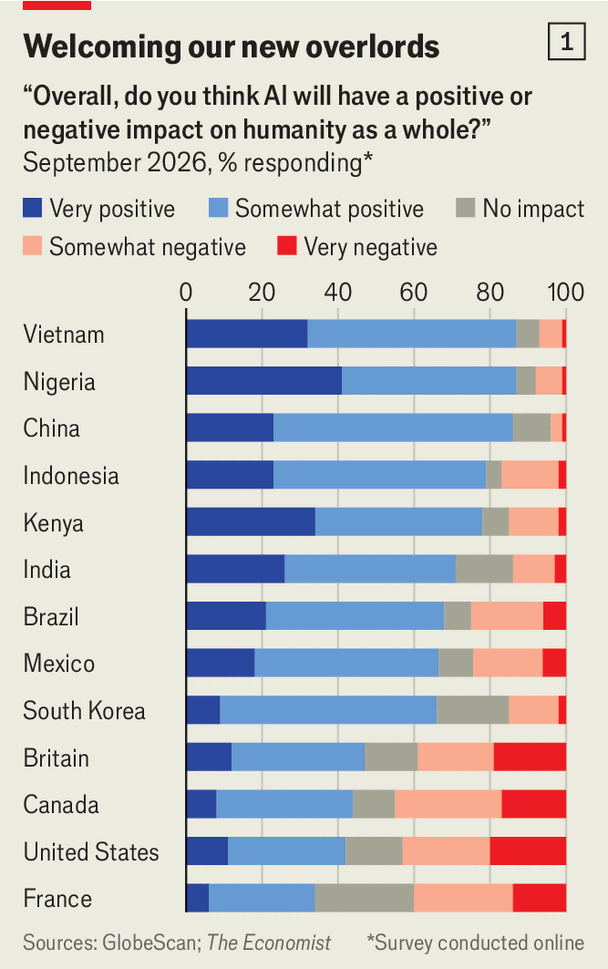
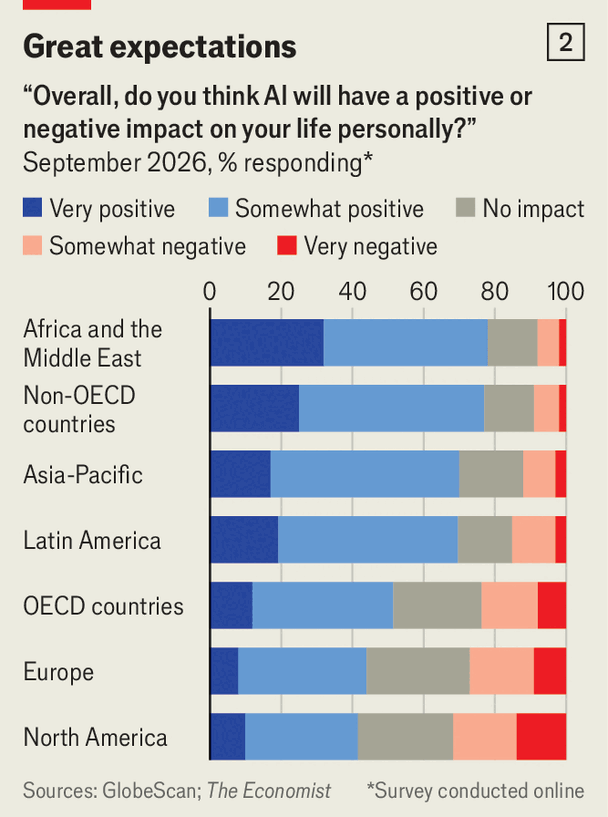
Read the headlines in Western media and it may seem as though a backlash(强烈抵制;反弹) to AI is spreading fast everywhere. But so far, it is not. Mr Bae’s sunny disposition about AI is shared by almost two-thirds of South Koreans, according to a survey that GlobeScan, a polling firm, conducted for The Economist.(民调公司GlobeScan为《经济学人》所做的一项调查显示,近三分之二的韩国人与裴先生一样,对人工智能持乐观态度。) Outside rich countries this good feeling is even more strongly shared: nearly nine in ten people in Nigeria and Vietnam, for example, said that AI will improve not only their own lives, but the lot of humanity(人类的命运) (see chart 1).
读一读西方媒体的头条,会让人觉得一场针对人工智能的抵制正在世界各地迅速蔓延。但到目前为止,事实并非如此。民调公司GlobeScan为《经济学人》所做的一项调查显示,近三分之二的韩国人与裴先生一样,对人工智能持乐观态度。在富裕国家之外,这种好感更为普遍:例如,尼日利亚和越南近九成受访者表示,人工智能不仅会改善他们自己的生活,也会改善全人类的命运(见图表1)。