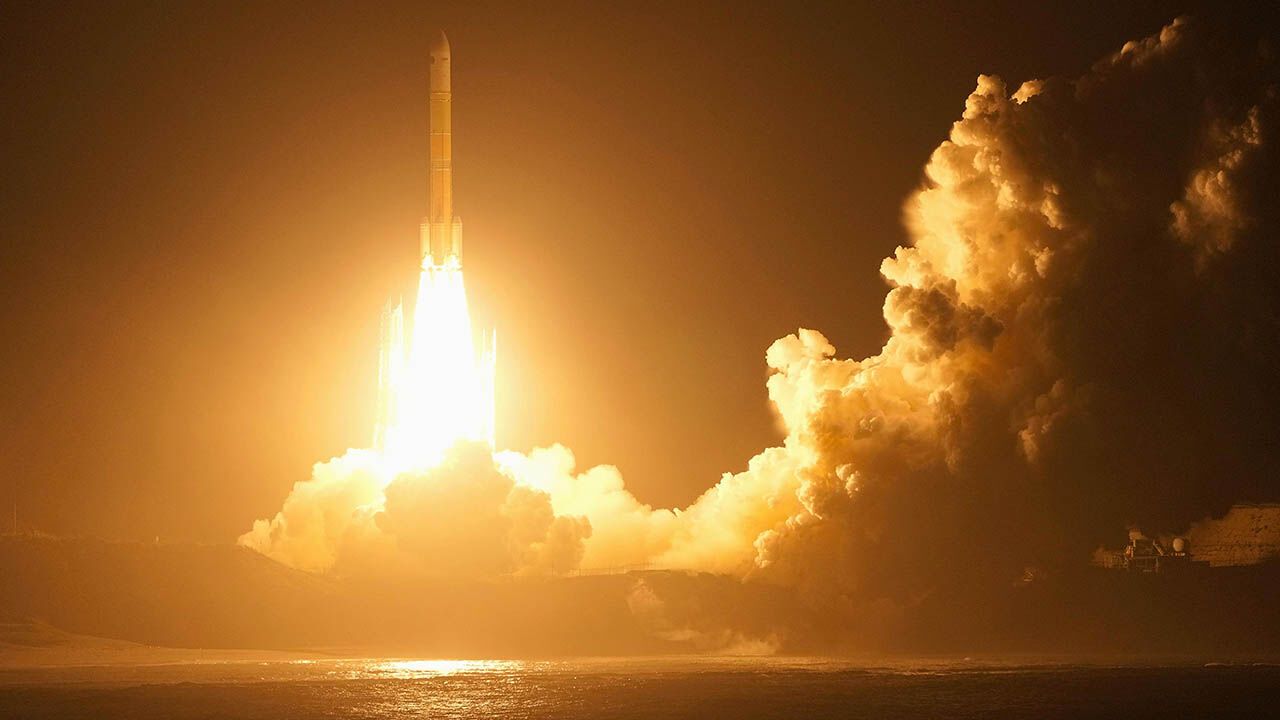
ORBITERS, LANDERS and rovers have travelled to Mars, but none has returned. The Japan Aerospace Exploration Agency (JAXA(日本宇宙航空研究开发机构)) intends for that to change. On October 20th its Martian Moons eXploration (MMX) mission lifted off(发射升空) from Tanegashima, an island in southern Japan. The probe will spend the next year travelling to Mars, where it aims to land on Phobos, the larger of the planet’s two moons, collect at least ten grams of rock and dust, and return the haul to Earth in 2031.(探测器将在接下来一年飞往火星,目标是在火卫一着陆、采集至少10克岩石和尘埃,并于2031年将样本带回地球。) Planetary scientists hope the mission will resolve a long-standing puzzle(解开长期谜题): how Mars’s moons were formed—and, in the process, reveal much about the planet itself.
轨道器、着陆器和巡视器都曾前往火星,但从未有探测器返回。日本宇宙航空研究开发机构(JAXA)打算改变这一局面。10月20日,其“火星卫星探测”(MMX)任务从日本南部的种子岛发射升空。探测器将在接下来的一年里飞往火星,目标是降落在火星两颗卫星中较大的火卫一(Phobos)上,采集至少10克岩石和尘埃,并于2031年将这批样本带回地球。行星科学家希望该任务能解开一个长期存在的谜题:火星的卫星是如何形成的——并在此过程中揭示关于火星本身的诸多信息。
Phobos and Mars’s other moon, Deimos, are small, respectively about 22km and 12km across, and look like lumpy(坑坑洼洼的) potatoes. That might suggest they are asteroids that were captured by Mars’s gravitational field after straying(偏离) too close. Captured asteroids, however, usually have tilted, elliptical orbits, whereas both moons follow nearly circular paths around the planet’s equator.(然而,被捕获的小行星通常具有倾斜的椭圆轨道,而这两颗卫星却都沿着近乎圆形的路径绕火星赤道运行。) That hints at(暗示) another possible origin: a giant collision that threw debris into orbit that later gathered into moons.
火卫一和火星的另一颗卫星火卫二(Deimos)都很小,直径分别约为22公里和12公里,形状像坑坑洼洼的土豆。这或许暗示它们是被火星引力场捕获的小行星,因偏离轨道靠得太近而被俘获。然而,被捕获的小行星通常具有倾斜的椭圆轨道,而这两颗卫星却都沿着近乎圆形的路径绕火星赤道运行。这暗示了另一种可能的起源:一次巨大撞击将碎片抛入轨道,碎片后来聚集形成了卫星。
JAXA has spent over a decade developing MMX, working with the space agencies of America, Europe and Australia. The mission builds on(建立在……基础上) Japan’s record of returning samples from space. Its Hayabusa(日本小行星采样任务) mission collected small amounts of grains from Itokawa, an asteroid which comes close to Earth, and brought them home in 2010. Its successor(继任者), Hayabusa2, brought back five grams of material—well above the mission’s target—from Ryugu, another near-Earth asteroid, in 2020. The samples proved rich in water-bearing molecules and organic compounds, offering clues to how asteroids may have carried the ingredients for life to Earth.(这些样本被证明富含含水分子和有机化合物,为小行星可能如何将生命的原料带到地球提供了线索。)
JAXA花了十多年时间开发MMX,并与美国、欧洲和澳大利亚的航天机构合作。该任务建立在日本从太空带回样本的纪录之上。其“隼鸟”任务从靠近地球的小行星“丝川”上采集了少量颗粒,并于2010年带回地球。其继任者“隼鸟2号”于2020年从另一颗近地小行星“龙宫”带回5克物质——远超任务目标。这些样本被证明富含含水分子和有机化合物,为小行星可能如何将生命的原料带到地球提供了线索。