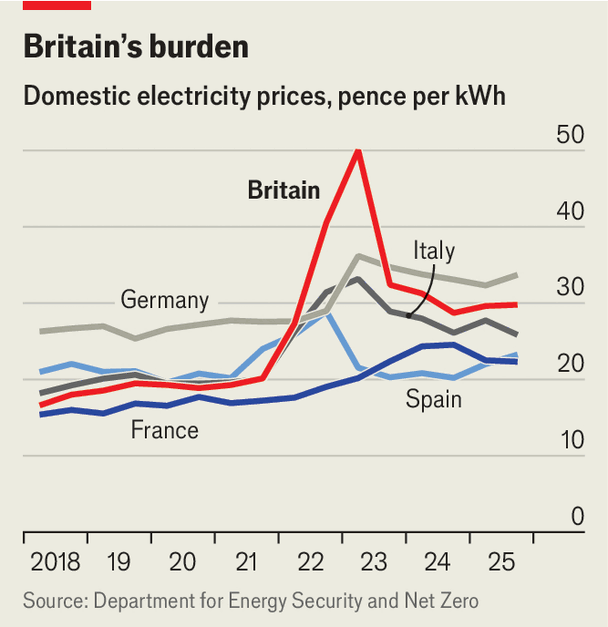
British households and businesses have struggled(艰难应对) with expensive energy for years. Firms in the country pay more than in any EU member state. Domestic consumers are near the top of that undesirable league table(排名表) (see chart).
多年来,英国的家庭和企业一直饱受能源价格高昂之苦。英国企业支付的能源费用高于任何欧盟成员国。国内消费者在这份不光彩的排行榜上也名列前茅(见图表)。
Cheaper rather than(而不是) greener power was the promise from John Healey, the chancellor(财政大臣), in his budget on October 28th. He signalled a shift away from prioritising low-carbon electricity generation at all costs(不惜一切代价). “From this point, our Labour government priority is first and foremost(首要的是) cheaper energy,” he said.
财政大臣约翰·希利在10月28日的预算中承诺,要提供更便宜而非更绿色的电力。他暗示将不再不惜一切代价优先发展低碳发电。他说:“从现在起,我们工党政府的首要任务是更便宜的能源。”
He proposed a handful of(少量的) short-term measures and some longer-term ambitions. Most Britons will get a one-off(一次性的) payment of £100 ($133) this winter. A previous decision to remove value-added tax from bills temporarily will be extended. The “standing charge” on gas bills, a daily payment to stay connected to the network, will be removed and a planned levy(征税) which would have funded hydrogen energy products is cancelled. Largely, this doesn’t change the underlying(根本的) costs; it just moves them around(转移成本).
他提出了一些短期措施和若干长期目标。大多数英国人今年冬天将获得100英镑(133美元)的一次性补贴。此前暂时取消账单增值税的决定将延长。燃气账单中的“固定费用”(即为了保持网络连接而每日支付的费用)将被取消,一项原本用于资助氢能产品的征税计划也被取消。总体而言,这并未改变根本成本,只是将成本转嫁到别处。