A YEAR AND a half ago Donald Trump was riding high(春风得意) and bent on(一心想要) reversing globalisation. As Americans fretted(发愁,焦虑) about the cost of living, the self-proclaimed(自封的) “Tariff Man” declared “chronic trade deficits” a “national emergency” and slapped hefty tariffs on(对……加征高额关税) imports. The protectionist mood spread. In August India’s prime minister, Narendra Modi, urged his fellow citizens to embrace swadeshi(印度自给自足运动) (self-sufficiency), insisting that not “a single foreign thing” should enter their homes. The European Union moved to double tariffs on steel imports. Mexico approved steep levies(征收的税款) on goods from China and other Asian economies. An index compiled by economists from the World Trade Organisation (WTO) and the IMF shows that restrictive(限制性的) trade measures rose by over 60% in 2025 alone.
一年半以前,唐纳德·特朗普正春风得意,一心想要逆转全球化。当时美国人为生活成本发愁,这位自封的“关税侠”宣布“长期贸易逆差”构成“国家紧急状态”,并对进口商品加征高额关税。保护主义情绪蔓延开来。去年8月,印度总理纳伦德拉·莫迪敦促同胞拥抱“斯瓦德希”(自给自足),坚称“一件外国货”都不该进入家门。欧盟着手将钢铁进口关税翻倍。墨西哥批准对来自中国及其他亚洲经济体的商品征收高额关税。世界贸易组织(WTO)和国际货币基金组织(IMF)的经济学家编制的一项指数显示,仅2025年一年,限制性贸易措施就增加了60%以上。
Yet for all(尽管) the protectionist fervour(热情,狂热), global trade today is booming. Since the final quarter of 2024, just before Mr Trump returned to office, the dollar value of world trade has surged(激增) by more than 27%. The pace has accelerated this year. In the first eight months of 2026 it was up by 18% on the same period last year, a remarkable pace by historical standards. Even by volume, trade is expected to grow faster than the world economy for a second year running(连续第二年)—a hallmark(标志,特征) of globalisation’s heyday(鼎盛时期) before the financial crisis of 2007-09.
然而,尽管保护主义情绪高涨,当今全球贸易却欣欣向荣。自2024年第四季度——即特朗普重返白宫前夕——以来,世界贸易的美元价值已飙升逾27%。今年增速进一步加快。2026年前八个月,贸易额同比增长18%,以历史标准衡量堪称惊人。即便按实物量计算,贸易增速预计也将连续第二年超过世界经济增速——这是2007至2009年金融危机前全球化鼎盛时期的标志性特征。
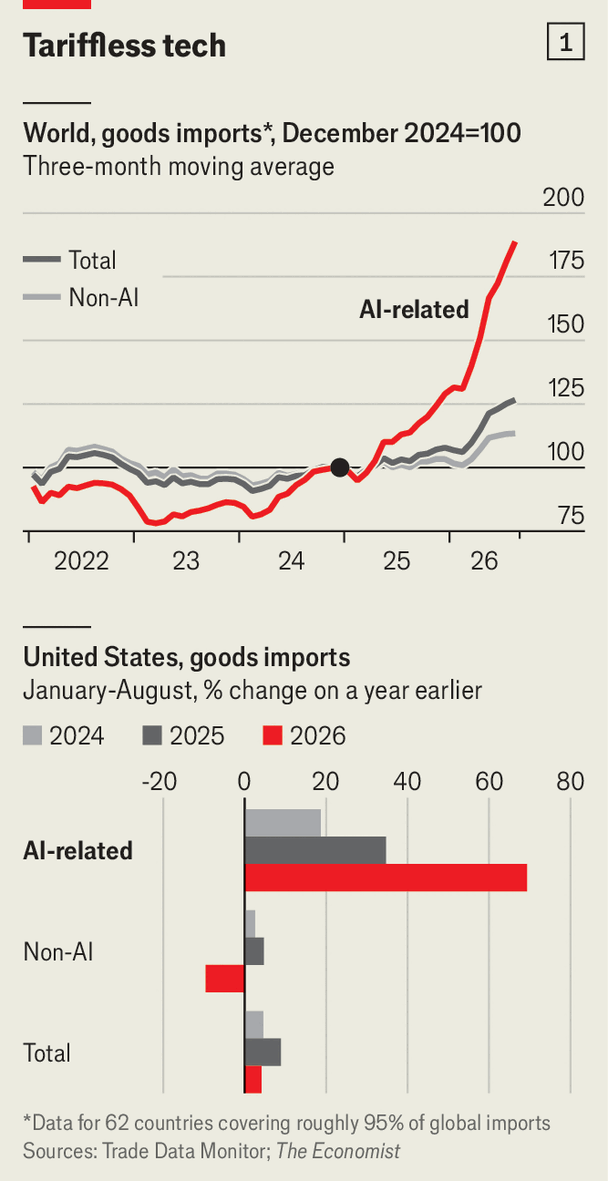
Free traders can thank artificial intelligence. As firms race to build data centres, trade in the servers, chips and networking equipment that power them has soared.(随着企业竞相建设数据中心,为数据中心供电的服务器、芯片和网络设备贸易一路飙升。) Governments, eager to build AI capabilities at home, have largely spared foreign hardware from tariffs. Using the WTO’s classification of AI-related goods, The Economist calculates that trade in such products exploded by 55% in the first eight months of 2026, compared with a year earlier.(利用WTO对AI相关商品的分类,《经济学人》计算得出,2026年前八个月此类产品贸易同比暴增55%。) Strip out AI-related goods and world trade is still growing, but at a far less impressive pace (see chart 1, top panel). AI hardware accounts for about a quarter of world imports, up from 15% in 2023. Protectionists, it seems, have learned to love free trade when it suits them(在符合自身利益时).
自由贸易的拥趸要感谢人工智能。随着企业竞相建设数据中心,为数据中心提供动力的服务器、芯片和网络设备贸易一路飙升。各国政府渴望在本国建立AI能力,因此基本上没有对进口硬件加征关税。利用WTO对AI相关商品的分类,《经济学人》计算得出,2026年前八个月此类产品贸易同比暴增55%。剔除AI相关商品,世界贸易仍在增长,但增速远没有那么亮眼(见图1上)。AI硬件约占世界进口的四分之一,高于2023年的15%。看来,保护主义者已经学会在符合自身利益时爱上自由贸易。