Jacob Ramirez, a 31-year-old operations manager for a café chain, has long struggled to make ends meet(勉强维持生计). In college he used a credit card to buy textbooks; after graduating, he occasionally did so to pay rent and utility(公用事业费用) bills. By 2022 he, his wife and their dog were in a one-bedroom flat in Pomona, east of Los Angeles. But rising rent and other expenses—“like an anaconda snake choking me out(让我窒息)”—pushed him deeper into debt. In 2023, owing $28,000 on five cards, Mr Ramirez turned to a non-profit debt-counselling(债务咨询) service. He is on track to(有望按计划实现) pay his debts by 2028.
31岁的雅各布·拉米雷斯是一家咖啡馆连锁店的运营经理,长期以来一直入不敷出。大学时他曾用信用卡购买教科书;毕业后,他偶尔也靠信用卡支付房租和水电费。到2022年,他和妻子以及他们的狗住在洛杉矶以东波莫纳的一套一居室公寓里。但不断上涨的房租和其他开支——“像一条蟒蛇把我勒得喘不过气来”——让他债台高筑。2023年,拉米雷斯五张信用卡共欠下2.8万美元,他求助于一家非营利债务咨询服务机构。他有望在2028年前还清债务。
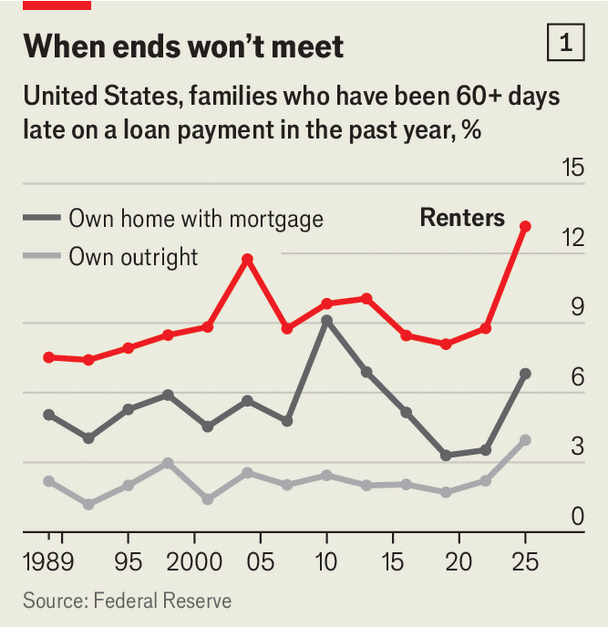
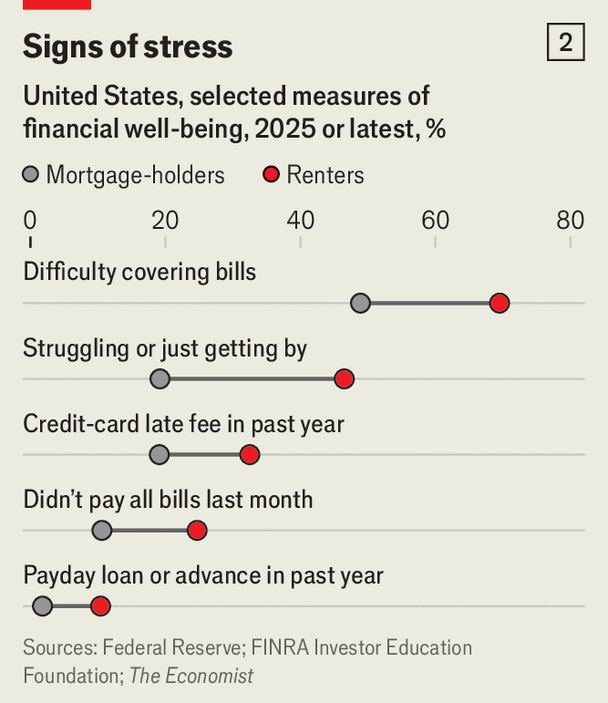
America’s economy is growing steadily, thanks to(得益于) an artificial-intelligence boom and robust(强劲的) consumer spending. But for three or four years a divide(鸿沟、分化) has been opening between homeowners and renters like Mr Ramirez, who make up a third of American households. An analysis by The Economist suggests that tenant(租户)s are increasingly missing payments(拖欠还款) and turning to(转向、求助于) costly short-term credit, even as homeowners’ finances remain resilient(有韧性的、稳健的). Is America experiencing a renters’ recession(租户衰退:租户群体特有的经济困境)?
得益于人工智能热潮和强劲的消费支出,美国经济稳步增长。但三四年来,房主与像拉米雷斯这样的租户之间逐渐裂开一道鸿沟——租户占美国家庭的三分之一。《经济学人》的一项分析表明,租户越来越多地拖欠还款并转向高成本的短期信贷,而房主的财务状况却依然稳健。美国是否正在经历一场“租户衰退”?
Their difficulties represent a turnaround(逆转、转变). During the global financial crisis of 2007-09 it was homeowners who suffered. By 2010 one in 20 mortgages was in foreclosure(止赎、丧失抵押品赎回权) and one in ten delinquent(逾期未还的). House prices had fallen by nearly a quarter; nearly one in four homeowners owed more than their dwellings were worth.(房价下跌了近四分之一;近四分之一的房主欠款超过其房产价值。)
他们的困境标志着一种逆转。在2007-09年全球金融危机期间,受苦的是房主。到2010年,每20笔抵押贷款中就有一笔被止赎,每十笔中就有一笔逾期。房价下跌了近四分之一;近四分之一的房主欠款超过其房产价值。