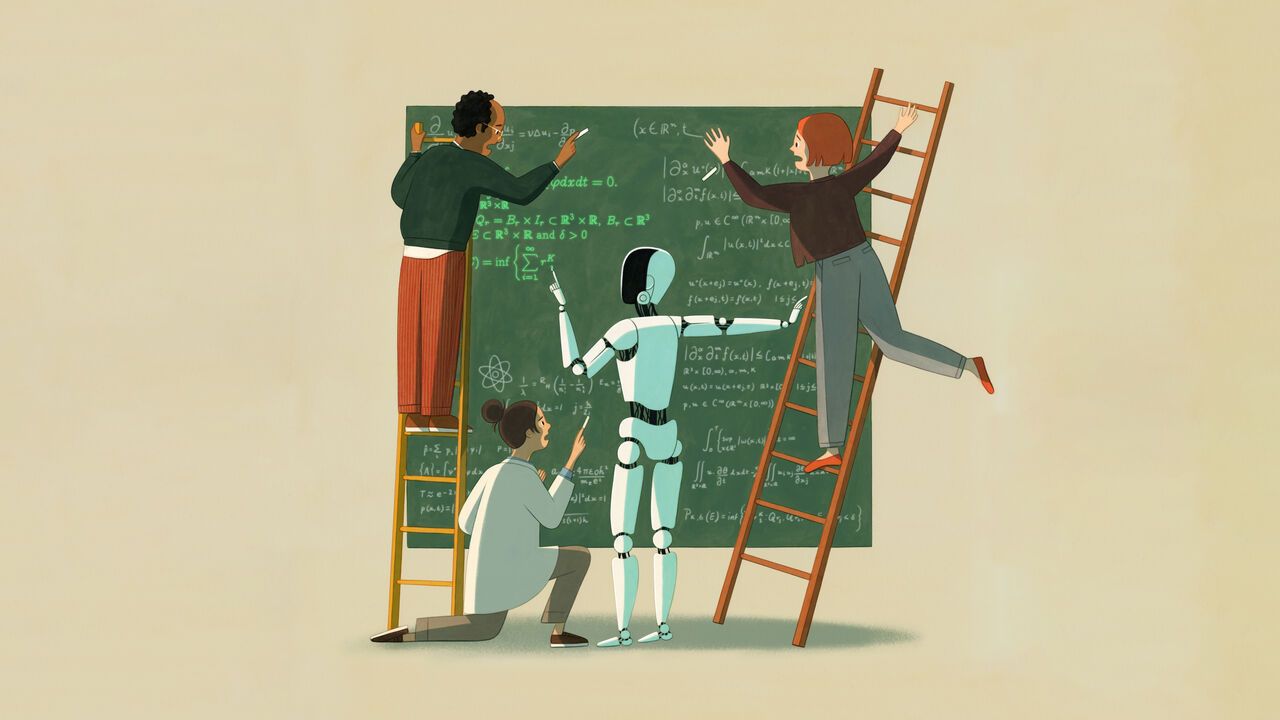
On October 29th leading mathematicians gathered at the Royal Society(英国皇家学会,世界最古老的科学学术团体) in London to discuss the future of their field. There was plenty of excitement at the progress artificial intelligence is making, leavened with nostalgia for the good old days of early 2026 when human-led mathematics was the only game in town.(人工智能取得的进展令他们兴奋不已,但同时也夹杂着对2026年初美好旧时光的怀念——那时,人类主导的数学还是唯一的选择。)
10月29日,顶尖数学家齐聚伦敦皇家学会,探讨数学领域的未来。人工智能取得的进展令他们兴奋不已,但同时也夹杂着对2026年初美好旧时光的怀念——那时,人类主导的数学还是唯一的选择。
Many attendees were also critical of how AI labs have been handling their models’ breakthroughs. In recent months labs have flooded the field with papers that are almost impenetrable to human minds, and kept the details of new results under wraps.(近几个月来,各实验室向该领域灌输了大量人类几乎无法理解的论文,并将新成果的细节秘而不宣。) Such secrecy, say mathematicians, increases the chance of needless errors and risks creating an illusion of progress(进步的假象). They do not feel the labs are keeping their promises to be more transparent.
许多与会者还批评了AI实验室处理其模型突破的方式。近几个月来,各实验室向该领域灌输了大量人类几乎无法理解的论文,并将新成果的细节秘而不宣。数学家们表示,这种保密做法增加了不必要的错误风险,并可能制造进步的假象。他们觉得实验室并未兑现更加透明的承诺。
Take the announcement by OpenAI, an American lab, on October 26th, of solutions to three more long-standing problems. The first is a proof of the Kakeya conjecture, related to how to rotate an infinitely thin needle while sweeping out as little area as possible.(第一个是挂谷猜想的证明,该猜想涉及如何旋转一根无限细的针,同时扫过尽可能小的面积。) Thus far the conjecture(猜想) had been found to hold in up to three dimensions. OpenAI said its proof extends it to any number.
以美国实验室 OpenAI 在10月26日宣布解决另外三个长期存在的问题为例。第一个是挂谷猜想的证明,该猜想涉及如何旋转一根无限细的针,同时扫过尽可能小的面积。迄今为止,该猜想被发现在最多三个维度内成立。OpenAI 表示,其证明将其扩展到了任意维度。