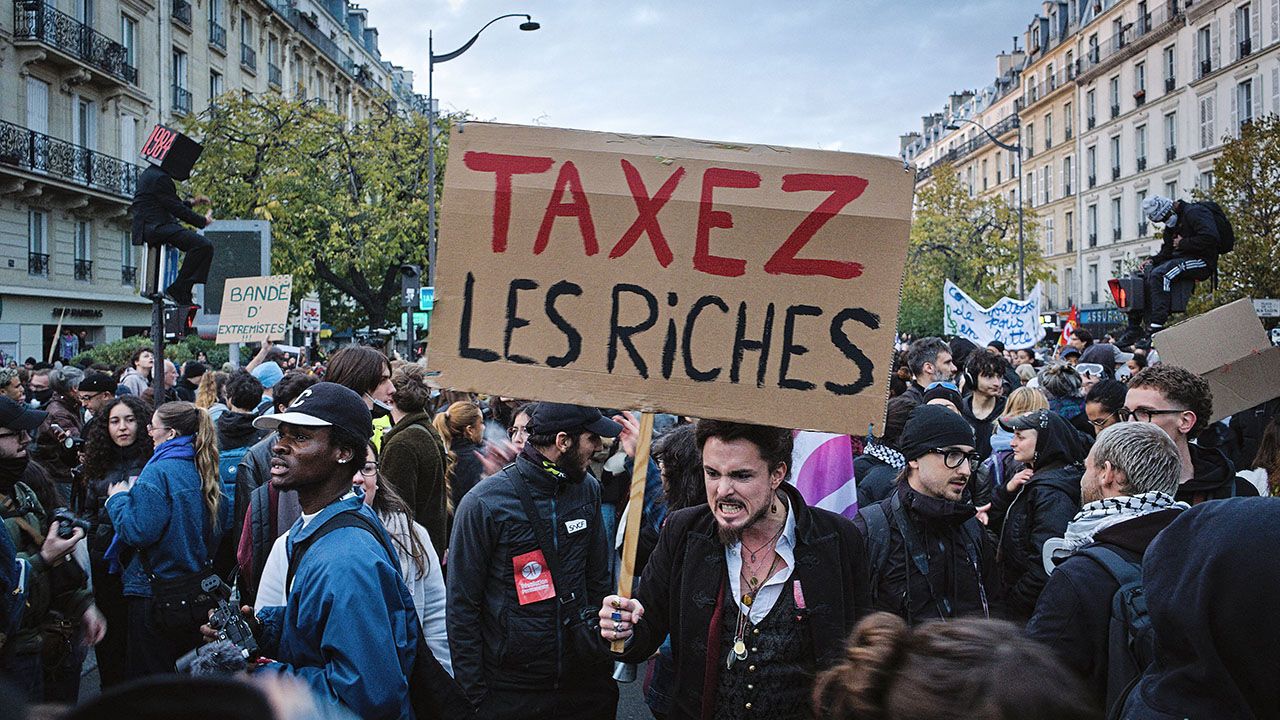
Europe’s COBBLED squares have echoed this autumn to the sound of police sirens and shattered glass. The continent is undergoing one of those periodic spasm(痉挛;阵发)s, when parliamentary politics struggle to handle social discontent. In France and Germany, protests began against underinvestment in education. In Spain and Italy, it was a housing crisis. Across the continent there is anger at rising prices. The shared underlying problem is this: many Europeans want levels of public spending they can no longer afford, while fragmented parliaments and populist politics make it almost impossible to fix the problems.(共同的深层问题是:许多欧洲人想要的公共支出水平已负担不起,而分裂的议会和民粹政治又让问题几乎无法解决。)
今年秋天,欧洲的鹅卵石广场上回荡着警笛声和玻璃碎裂声。这片大陆正经历周期性的痉挛——议会政治难以应对社会不满。在法国和德国,抗议最初针对教育投入不足;在西班牙和意大利,导火索是住房危机;整个欧洲大陆,人们都在为物价上涨而愤怒。共同的深层问题在于:许多欧洲人想要维持的公共支出水平,他们已经负担不起;而碎片化的议会和民粹政治,又让解决问题几乎无从下手。
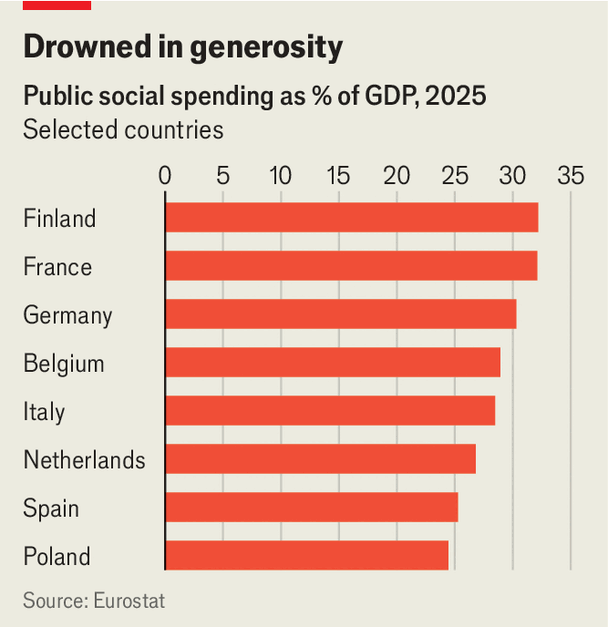
For decades Europe has offered its citizens an unusually comfortable level of benefits and protections. European Union countries spend 10% of GDP on public pensions, on average, nearly twice the share in America. EU countries devote nearly 30% of GDP to public social spending, compared with less than 20% in America. Angela Merkel, a German former chancellor, once noted with disapproval that Europe accounts for 7% of the world’s population, 25% of global GDP and 50% of global social spending.(德国前总理默克尔曾不以为然地指出,欧洲占世界人口的7%、全球GDP的25%,却占全球社会支出的50%。) Europe, she concluded, “will have to work very hard to maintain its prosperity(繁荣;富裕) and way of life.”
几十年来,欧洲为其公民提供了异常优厚的福利与保障。欧盟国家平均将GDP的10%用于公共养老金,几乎是美国的两倍。欧盟国家将近30%的GDP用于公共社会支出,而美国不到20%。德国前总理安格拉·默克尔曾不以为然地指出,欧洲占世界人口的7%、全球GDP的25%,却占全球社会支出的50%。她得出结论:欧洲“将不得不非常努力,才能维持其繁荣和生活方式”。
Some countries, notably hers and the Nordics, did the hard work and made the protective state more affordable, although even Germany is now facing a crunch(紧要关头;压力) over social spending. Less responsible countries have kept on borrowing and ducking hard choices(逃避艰难抉择). Five have public debt levels at or above 100% of GDP, including France, Italy and Spain. Ten, including Belgium, France and Italy, are now subject to(受制于;须遵守) the EU’s “excessive-deficit procedure(欧盟过度赤字程序)”. This is a sort of naughty step, designed to put those who break the union’s rules (which cap debt at 60% of GDP and budget deficits at 3% of GDP) under scrutiny and correct their wayward behaviour.(这有点像“罚站”,旨在把违反欧盟规则(债务上限为GDP的60%,预算赤字上限为GDP的3%)的国家置于审查之下,纠正其任性行为。)
一些国家——尤其是德国和北欧国家——付出了艰苦努力,让福利国家变得更可负担,尽管如今连德国也面临社会支出的压力。不那么负责任的国家则继续借债、逃避艰难抉择。有五个国家的公共债务达到或超过GDP的100%,包括法国、意大利和西班牙。包括比利时、法国和意大利在内的十个国家,目前受制于欧盟的“过度赤字程序”。这有点像“罚站”,旨在把违反欧盟规则(债务上限为GDP的60%,预算赤字上限为GDP的3%)的国家置于审查之下,纠正其任性行为。