The riots in France gave another airing(公开表达) to a familiar grievance(不满、怨言): that baby-boomers have cornered the market. After cushy(轻松舒适的) careers, the gripe goes, people born between the mid-1940s and mid-1960s own all the best houses and most of the stock market, while receiving generous pensions to boot(而且还). Politicians, knowing that these oldies vote in large numbers, fall over themselves(争先恐后) to hand them goodies(好处、甜头). Younger adults are stuck with expensive housing, insecure work and a crumbling(摇摇欲坠的) education system. In June Samuel Moyn of Yale University published a tome(巨著、大部头) on the scourge(祸患、灾祸), titled “Gerontocracy in America(莫因著作《美国的长者统治》)”.
法国的骚乱再次让一个人们耳熟能详的怨言有了宣泄的出口:婴儿潮一代已经垄断了市场。这种抱怨的说法是,出生于20世纪40年代中期至60年代中期的人,在度过了轻松舒适的职业生涯之后,拥有所有最好的房子和大部分股票市场,而且还拿着丰厚的养老金。政客们知道这些老年人投票率高,便争先恐后地给他们好处。而年轻人则被困在昂贵的住房、不稳定的工作和日益衰败的教育体系之中。今年6月,耶鲁大学的塞缪尔·莫因出版了一部论述这一祸患的巨著,题为《美国的长者统治》。
Mr Moyn’s book and the sentiment it reflects may, however, be out of date(过时的). A range of data analysed by The Economist suggests that the world has passed peak boomer(婴儿潮一代的巅峰). Elderly incomes are falling relative to those of working-age people, the young are accumulating more wealth and governments are introducing more policies that benefit the stripling(年轻人、小伙子). The unwinding(瓦解、逆转) of boomer communism(婴儿潮共产主义), as the phenomenon is less charitably described, is a ray of hope(一线希望) for indebted governments, which cannot afford to continue to lavish(慷慨给予) perks(额外福利) on an ageing population. It also suggests that Western political systems are less ossified(僵化的) than commonly assumed.
然而,莫因的书以及它所反映的情绪可能已经过时了。《经济学人》分析的一系列数据表明,世界已经过了婴儿潮一代的巅峰期。老年人的收入相对于劳动年龄人口正在下降,年轻人正在积累更多财富,各国政府也在推出更多惠及年轻人的政策。这一现象被不那么客气地称为“婴儿潮共产主义”,它的瓦解对负债累累的政府来说是一线希望——这些政府已无力继续向老龄化人口慷慨发放福利。这也表明,西方政治体系并不像人们通常以为的那样僵化。
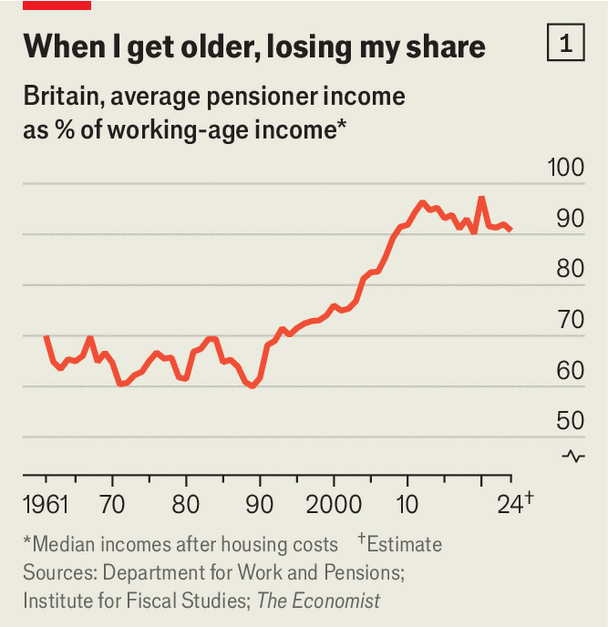
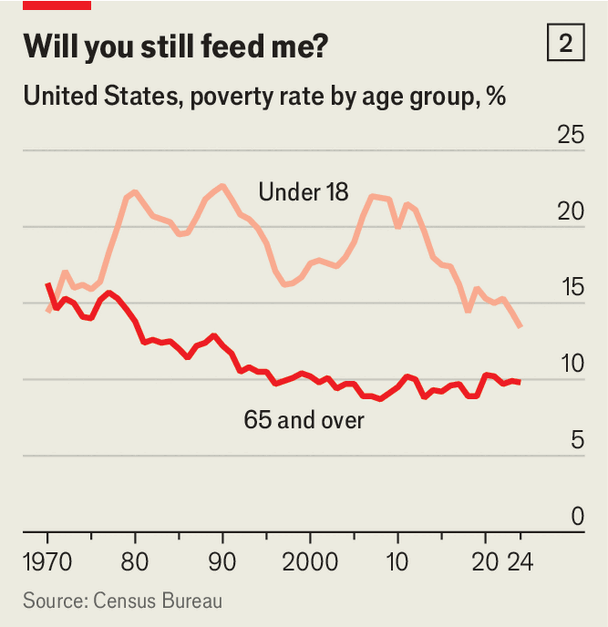
Boomer communism was the result of the postwar settlement(战后和解安排). The welfare system of the 1950s and 1960s treated working men well but did far less for everyone else. Many older people, women in particular, made do with(勉强应付) meagre(微薄的) occupational pensions and quickly outlived(活得比…久) their savings. Old age was a synonym for destitution(赤贫). In America in the mid-1960s close to 30% of people over the age of 65 had incomes below a threshold(门槛、界限) required to meet basic needs, compared with just 10% of working-age folk(劳动年龄人口). In Canada in 1976 (the earliest available data) 47% of elderly households were poor (under a looser definition), versus 15% of 18- to 64-year-olds. Even when pensioners were not poor, they were rarely rich. In Britain in 1961 the income, after benefits, taxes and housing costs, of the median pensioner was 30% lower than that of the median person of working age.(1961年的英国,普通养老金领取者在扣除福利、税收和住房成本后的收入,比普通劳动年龄人口低30%。)
“婴儿潮共产主义”是战后和解的产物。20世纪50年代和60年代的福利制度对在职男性照顾有加,对其他人的帮助却少得多。许多老年人,尤其是女性,只能靠微薄的职业养老金勉强度日,积蓄很快就不够用了。那时,老年就是贫困的代名词。20世纪60年代中期,美国65岁以上人口中近30%的收入低于满足基本需求所需的门槛,而劳动年龄人口中这一比例仅为10%。1976年的加拿大(有数据可查的最早年份),47%的老年家庭属于贫困(按较宽松的定义),而18至64岁人群中这一比例为15%。即便养老金领取者不算贫困,他们也很少富裕。1961年的英国,普通养老金领取者在扣除福利、税收和住房成本后的收入,比普通劳动年龄人口低30%。