“We should always be afraid of many things,” muses(沉思地说) Andrei Roman. “There’s not much we can do about them, though.” His gloom(忧郁;悲观) is not for humanity in general, but for one of its less celebrated endeavours(不太受赞誉的事业): election polling.
“我们总该对许多事情心存畏惧,”安德烈·罗曼若有所思地说。“不过,我们对此也做不了什么。”他的悲观并非针对整个人类,而是针对人类一项不太受赞誉的事业:选举民调。
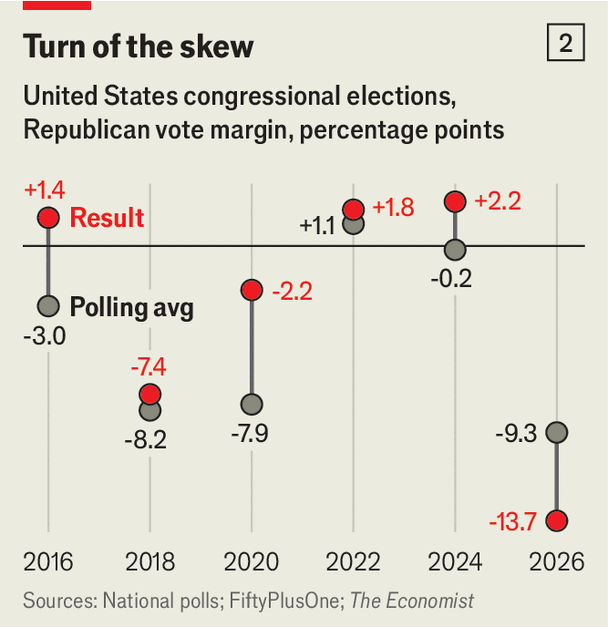
Mr Roman’s polling firm, AtlasIntel, was spot on(完全正确;准确无误) in its soundings(调查;民意测验) of American voters before the recent midterm elections. But most pollsters underestimated the Democrats’ support. And AtlasIntel did get it wrong twice in Brazil’s recent presidential election, first suggesting that Luiz Inácio Lula da Silva, the left-wing incumbent, would win the first round of voting and then that Flávio Bolsonaro, his opponent, was ahead in the run-off.(而AtlasIntel在巴西最近的总统选举中确实错了两次:先是暗示左翼现任总统卢拉将赢得第一轮投票,随后又显示其对手弗拉维奥·博索纳罗在第二轮决选中领先。) Many other pollsters made the same mistake.
罗曼的民调公司AtlasIntel在近期中期选举前对美国选民的调查完全准确。但大多数民调机构低估了民主党的支持率。而AtlasIntel在巴西最近的总统选举中确实错了两次:先是暗示左翼现任总统路易斯·伊纳西奥·卢拉·达席尔瓦将赢得第一轮投票,随后又显示其对手弗拉维奥·博索纳罗在第二轮决选中领先。许多其他民调机构也犯了同样的错误。
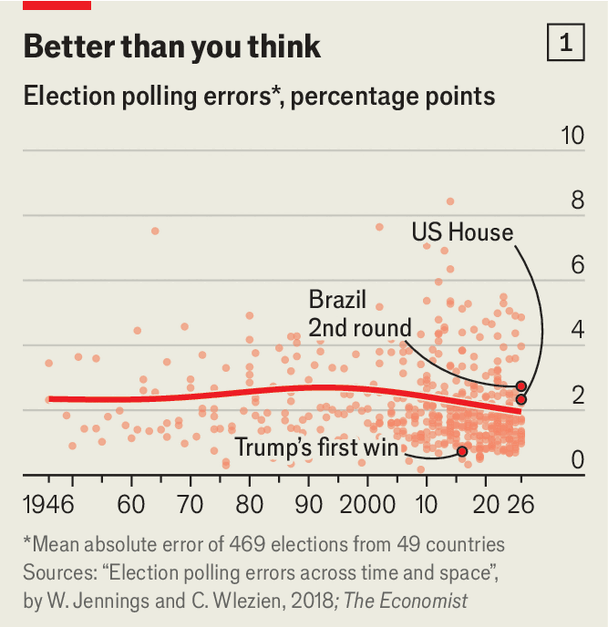
Are polls getting worse? Our analysis suggests not. Building on(基于;在……基础上) a dataset created by Will Jennings and Christopher Wlezien, two professors of political science, The Economist analysed polls of 469 elections in 49 countries between 1946 and 2026. Over the past 80 years, we found, polls have become slightly more accurate. An average of polls conducted within ten days of an election predicts a given party or candidate’s share of the vote with a mean error of just two percentage points (see chart 1).(在选举前十天內进行的民调平均值,预测某政党或候选人得票率的平均误差仅为两个百分点(见图表1)。)
民调是否越来越差?我们的分析表明并非如此。基于政治学教授威尔·詹宁斯和克里斯托弗·弗莱齐恩创建的数据集,《经济学人》分析了1946年至2026年间49个国家469场选举的民调。我们发现,过去80年里,民调变得略微更加准确。在选举前十天內进行的民调平均值,预测某政党或候选人得票率的平均误差仅为两个百分点(见图表1)。
Totem polls
图腾民调