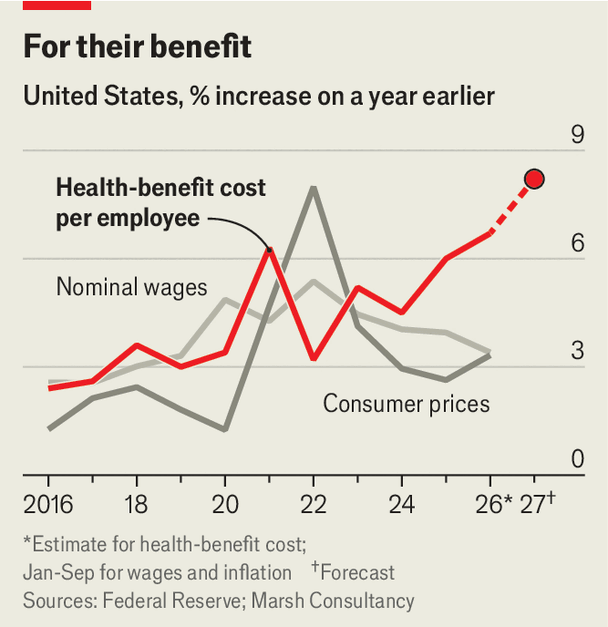
Health care ranks high on(在……中占据重要位置) Democrats’ agenda(议程;议事日程) in Congress, as they seek to restore subsidies(补贴) to buy individual insurance and reverse(逆转;撤销) cuts to Medicaid(美国面向低收入人群的公共医疗保险项目), the health programme for the poor. However, a different problem looms(逼近;隐现), too. In the coming weeks, the 157m Americans who receive insurance through employers will have to choose a plan for next year.(未来几周,1.57亿通过雇主获得保险的美国人将不得不为明年选择保险计划。) The cost of their insurance is due to rise by an average of 8% in 2027, according to Marsh, a consultancy(咨询公司), the biggest price hike(价格上涨;涨价) in more than 20 years.
医疗保健在国会民主党人的议程中占据重要位置,他们试图恢复购买个人保险的补贴,并逆转对穷人医疗项目Medicaid的削减。然而,另一个问题也迫在眉睫。未来几周,1.57亿通过雇主获得保险的美国人将不得不为明年选择保险计划。咨询公司Marsh的数据显示,2027年他们的保险成本预计平均上涨8%,为二十多年来最大涨幅。
Employer-sponsored health care has long been the backbone(支柱;骨干) of American coverage. About half of Americans get their health insurance through their job, that of their spouse or their parents. But as health insurance gets ever more expensive, bosses are looking for ways to trim their spending, whether through making workers pay for more of their care in cash, cutting coverage or even scrapping health benefits entirely.(但随着医保越来越贵,老板们正在寻找削减开支的办法:让员工自掏腰包承担更多医疗费用、削减保障范围,甚至完全取消医疗福利。) Already, six in ten(十分之六;六成) Americans worry about affording(负担得起) health care, according to KFF, a health-research outfit(机构;组织), a higher share than worry about petrol. As employers strip back(削减;缩减) coverage, that anxiety is sure to rise.
雇主医保长期以来一直是美国医保体系的支柱。约一半美国人通过自己的工作、配偶或父母获得医疗保险。但随着医保越来越贵,老板们正在寻找削减开支的办法:让员工自掏腰包承担更多医疗费用、削减保障范围,甚至完全取消医疗福利。健康研究机构KFF的数据显示,已有六成美国人担心负担不起医疗费用,这一比例高于担心油价的人。随着雇主削减保障,这种焦虑势必加剧。
Because health premiums paid by employers are excluded from income and payroll taxes, the government incentivises bosses to compensate workers by offering them health insurance.(由于雇主支付的医保保费免征所得税和工资税,政府实际上在激励老板通过提供医保来补偿员工。) However, employers are problematic middle men(中间人;中间商). An employer generally covers about 80% of an insurance plan’s cost, with staff paying the remaining 20% themselves, or an average of $7,500 for a family plan. Fast-growing insurance costs borne(承担(bear 的过去分词)) by employers limit workers’ salaries, usually in a way that is not transparent to staff(以员工不知情的方式).
由于雇主支付的医保保费免征所得税和工资税,政府实际上在激励老板通过提供医保来补偿员工。然而,雇主是有问题的中间人。雇主通常承担保险计划约80%的费用,员工自己支付剩余的20%,家庭计划平均约7500美元。雇主承担的快速增长的保险成本会限制员工薪资,而这种限制通常对员工并不透明。
A thousand cuts
千刀万剐