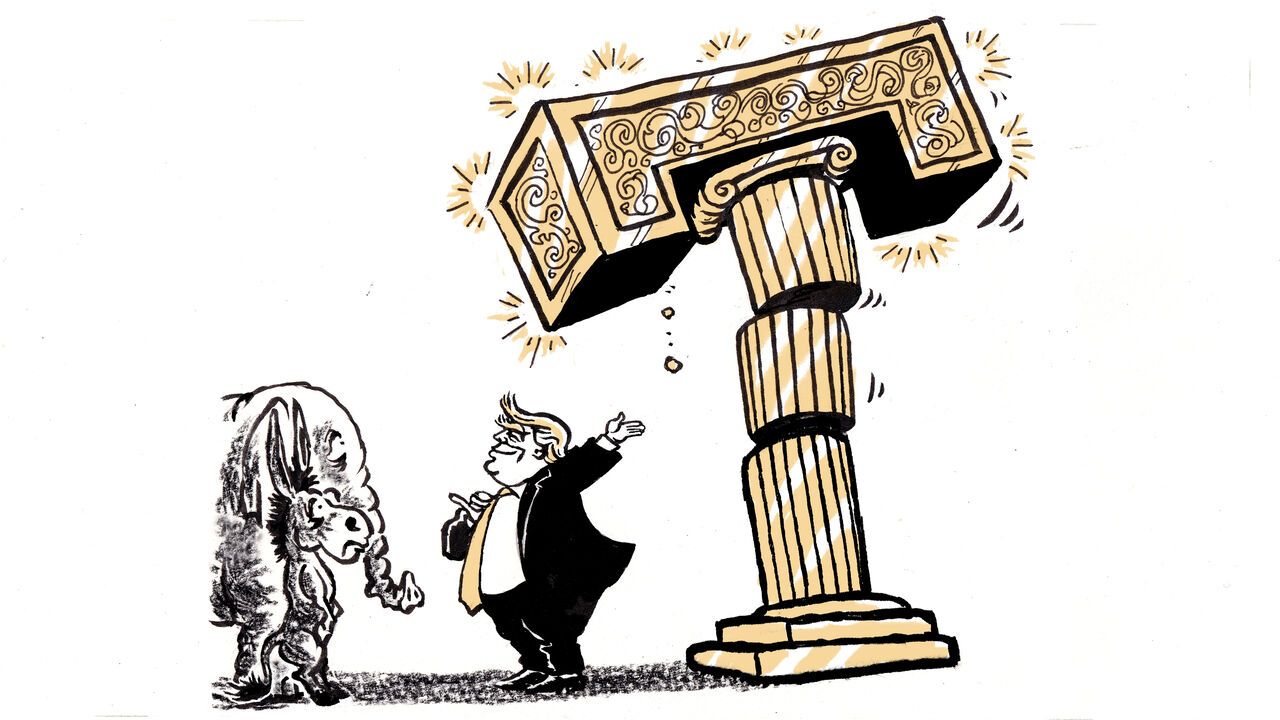
Not long ago, after a whopping(巨大的) defeat in midterm elections, the president made some conciliatory(和解的) noises and some belligerent(好斗的) ones. He issued a warning to the opposition party that was taking control of the House. “You can’t legislate and investigate simultaneously—it just doesn’t work that way,” he said. “You can’t go down two tracks(双轨并行) at the same time.” Yet when they did go down both tracks, he did, too, battling congressional investigations while collaborating with his congressional adversaries to achieve legislation on trade and the environment.(然而当他们真的双轨并行时,他也照做了,一边与国会调查作斗争,一边与国会对手合作,在贸易和环境问题上推动立法。) When crisis struck he worked with the House to deliver an historic economic rescue package—even though by then, in a party-line vote(按党派划线的投票), the opposition had impeached him.
不久前,在一场中期选举的惨败之后,总统发出了一些和解的声音,也发出了一些好斗的声音。他向正在接管众议院的反对党发出警告。“你不能同时既立法又调查——事情不是那样运作的,”他说。“你不能同时走两条轨道。”然而当他们真的双轨并行时,他也照做了,一边与国会调查作斗争,一边与国会对手合作,在贸易和环境问题上推动立法。当危机来袭时,他与众议院合作,推出了一项历史性的经济救助方案——尽管那时,反对党已经以党派划线投票弹劾了他。
That president was, of course, Donald Trump, in his first term. This time around, after an even bigger midterm rebuke(斥责、挫败), he is sending more intensely mixed signals(混杂的信号). He has floated the idea of working with Democrats to solve one of America’s most vexing(令人烦恼的) problems, its broken immigration system. Yet he has appointed as his chief of staff Stephen Miller, the enforcer of his brutal deportation agenda, whom Democrats despise and even some Republican legislators consider too hardline.(然而他却任命史蒂芬·米勒为幕僚长,此人是其残酷驱逐议程的执行者,民主党人对他深恶痛绝,甚至一些共和党议员也认为他过于强硬。) Given the priorities of(鉴于……的优先事项) the Democrats, particularly those elected from what were Republican states and districts, Mr Trump has a bigger opportunity than in his first term to make progress, including for the working-class voters he has always claimed to represent. One can hope. But the historical pattern, and this president’s particular pattern, suggest he won’t.
那位总统当然是第一任期的唐纳德·特朗普。这一次,在中期选举遭遇更大挫败之后,他发出的信号更加矛盾。他提出了与民主党合作解决美国最棘手问题之一——支离破碎的移民制度——的想法。然而他却任命史蒂芬·米勒为幕僚长,此人是其残酷驱逐议程的执行者,民主党人对他深恶痛绝,甚至一些共和党议员也认为他过于强硬。鉴于民主党的优先事项,尤其是那些从原共和党州和选区当选的民主党人,特朗普比第一任期有更大的机会取得进展,包括为他一直声称代表的工人阶级选民。人们可以抱有希望。但历史规律,以及这位总统的独特模式,表明他不会。
Freed from facing voters again, intent on a legacy and looking to history for vindication(证明正确、平反), second-term presidents tend not to retreat from signature positions(标志性立场) after midterm reversals(逆转、挫折), notes Frances Lee, a professor at Princeton. “They tend to take a hard line(采取强硬路线) and persist,” she says. President George W. Bush sent more troops to Iraq despite Americans’ despair over that war; President Barack Obama outraged(激怒) Republicans by using executive orders(行政命令) to protect some immigrants in the country illegally. Mr Trump has taken to brandishing(挥舞) a red hat emblazoned(印有) with the word “veto(否决)”, a familiar threat in his circumstances. In the first five and a half years of his presidency, Mr Bush issued not a single veto, a record surpassed only by Thomas Jefferson. After the crushing Democratic victory in 2006, he vetoed 11 bills, edging out Mr Obama, who, after his midterm drubbing in 2014, vetoed ten.(2006年民主党大胜后,他否决了11项法案,略胜奥巴马——后者在2014年中期选举惨败后否决了10项。)
普林斯顿大学教授弗朗西斯·李指出,第二任期总统不再面对选民,一心想留下政治遗产、寄望历史还其公道,因此在中期选举受挫后往往不会放弃标志性立场。“他们往往采取强硬路线并坚持下去,”她说。小布什总统不顾美国人对伊拉克战争的绝望,向伊拉克增派军队;奥巴马总统动用行政命令保护一些非法移民,激怒了共和党人。特朗普则喜欢挥舞一顶印有“否决”字样的红帽子,这在他这种处境下是常见的威胁。在小布什总统任期的前五年半里,他一次否决权都没用过,这一纪录只有托马斯·杰斐逊能超越。2006年民主党大胜后,他否决了11项法案,略胜奥巴马——后者在2014年中期选举惨败后否决了10项。