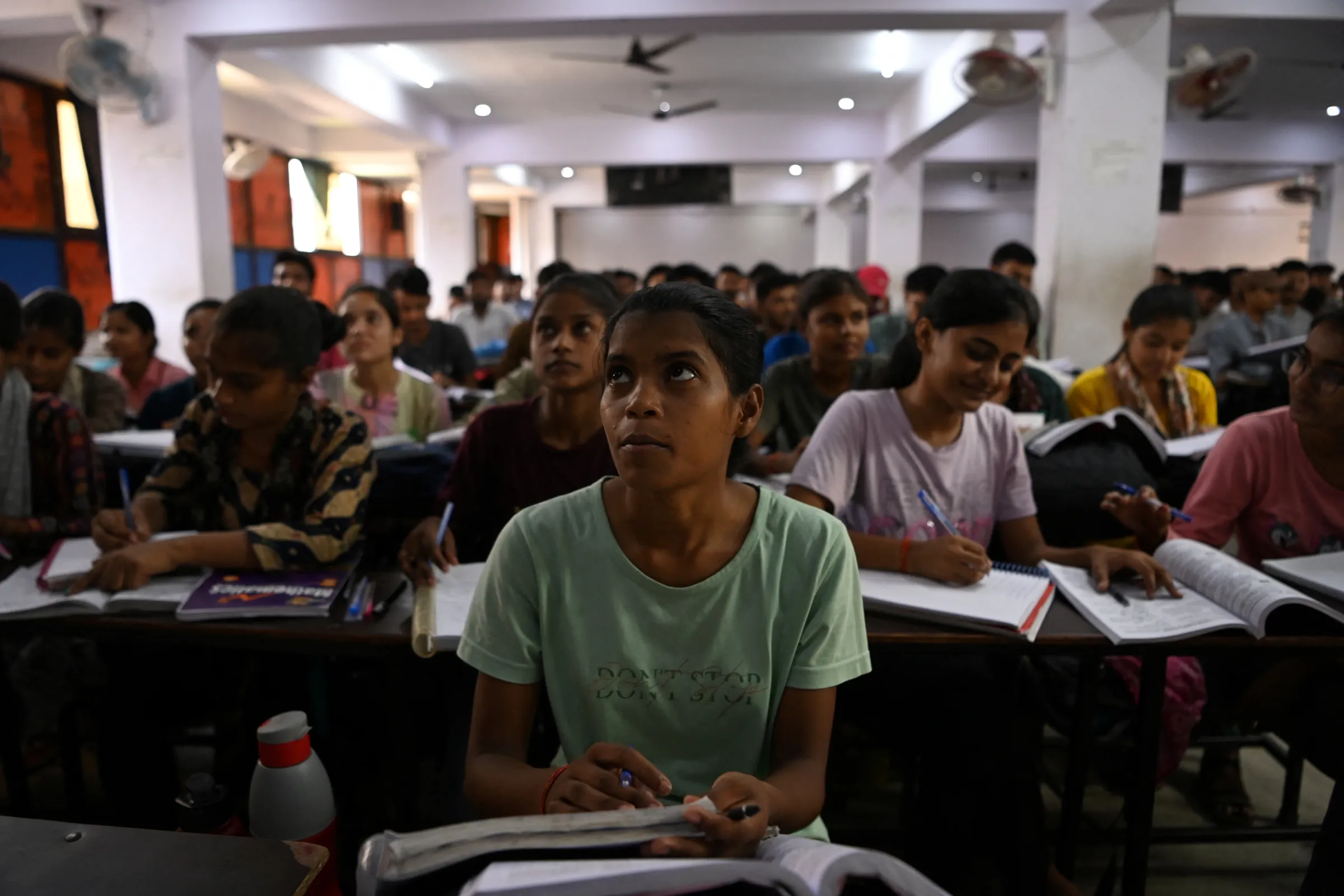
In December 2025, newspapers in India carried an arresting(引人注目的,令人震撼的), dystopian(反乌托邦的,黑暗社会的) image: scores of(大量,许多(强调数量多)) young people sitting obediently(顺从地,听话地) in rows on an airstrip in the eastern state of Odisha to take an exam. Over 8,000 test takers had lined up under the sun to compete for 187 posts in the police service. That so many people were willing to take an exam in such inhumane conditions is revealing. In India, government jobs have long been coveted because they bring financial security and a measure of social prestige. But the candidates in Odisha were vying for(竞争,争夺) the lowest rung(最底层(比喻最低职位)) of the police service. Such a large volume of candidates for such a poorly paid post reflects widespread desperation among educated youth. India’s economy has failed to generate opportunities for the country’s many young people, even as it has recorded an average annual GDP growth rate of six to seven percent over the past three decades.
2025年12月,印度报纸刊登了一幅令人震撼的反乌托邦画面:在东部奥里萨邦的一条飞机跑道上,成群的年轻人整齐地坐着参加考试。超过8000名应试者顶着烈日排队,竞争187个警察职位。如此多的人愿意在如此不人道的条件下参加考试,这很能说明问题。在印度,政府工作长期以来一直令人向往,因为它们能带来经济保障和一定的社会威望。但奥里萨邦的考生们争夺的是警察部门的最底层职位。如此多的候选人竞聘如此低薪的岗位,反映出受过教育的青年中普遍的绝望情绪。印度经济未能为该国众多年轻人创造机会,尽管过去三十年其年均GDP增长率高达6%至7%。
In the nearly 80 years since gaining its independence, in 1947, India has struggled to deliver broad-based prosperity(广泛基础的繁荣). In that time, its economy has been through several transitions. It first took the broadly socialist path of centralized planning, state-controlled industrialization through public enterprises, and the raising of barriers to foreign trade. That orientation produced tepid(温吞的,不温不火的) growth, averaging 2.5 percent between 1950 and 1980. India concertedly(协同一致地,齐心合力地) liberalized its economy in the 1990s, embracing reforms(拥抱改革,积极采纳改革) that accelerated growth and massively reduced(大幅减少) rates of extreme poverty, which fell from over 50 percent in the early 1980s to less than 20 percent by 2010.
自1947年独立以来的近80年里,印度一直在努力实现广泛繁荣。在此期间,其经济经历了多次转型。它最初采取了广泛的社会主义道路:中央计划、通过国有企业实现国有控制的工业化、以及提高对外贸易壁垒。这种取向导致增长温吞,1950年至1980年间平均仅2.5%。印度在1990年代协同推进经济自由化,拥抱改革,加速了增长,并大幅降低了极端贫困率,从1980年代初的超过50%下降到2010年的不到20%。
But India failed to engender(产生,引起(正式)) a deeper economic transformation. Most Indians remain stuck in(被困在……中) low-quality, low-productivity jobs: as of 2024, 46 percent of the country’s workers were thought to be in agriculture, according to government data. India’s failings are stark(鲜明的,明显的(常指负面)) when viewed comparatively. Its per capita GDP is less than one-fourth that of Brazil and one-sixth that of Turkey, two other aspirational(有抱负的,渴望成为的) middle powers. The gains from growth have been staggeringly(令人震惊地(强调程度)) unequal. India has more billionaires—205, according to a 2025 Forbes estimate—than any other country apart from the United States and China. At the same time, millions of young people ready to enter the workforce every year find few jobs on offer.
但印度未能实现更深层的经济转型。大多数印度人仍然困在低质量、低生产率的工作中:根据政府数据,截至2024年,该国46%的劳动力被认为从事农业。比较来看,印度的失败是鲜明的。其人均GDP不到巴西的四分之一、土耳其的六分之一,这两个同样是抱负不凡的中等强国。增长的收益极度不平等。印度的亿万富翁数量(根据2025年福布斯估计为205人)仅次于美国和中国。与此同时,每年数百万准备好进入劳动力市场的年轻人却发现工作机会寥寥无几。
THE PARADOXICAL STATE
矛盾的国家
ON INDIAN SOIL
在印度土壤上
LABORATORIES OF DEMOCRACY
民主实验室