What’s your story? The story that you live by(以……为生活准则), that your cells are geared(使适应;使准备好) to, even or especially when you’re not thinking about it? Do we create our own meaning, or should we be trying to discover the meaning that created us? Is it the tractor beams(牵引光束) of heavenly love that hold us here, like God’s guy ropes(拉索;固定绳), or are we adrift(漂泊无依;随波逐流)?
你的故事是什么?那个你赖以为生、你的细胞天生就为之运转的故事,即便——或者说尤其——在你没有意识到它的时候?是我们自己创造意义,还是应该努力去发现那个创造了我们的意义?是天堂之爱的牵引光束将我们固定在此,如同上帝的拉索,还是我们其实在随波逐流?
When George Lucas, a long time ago in a galaxy far, far away(很久以前,在一个遥远的星系), began writing the screenplay for Star Wars, he had a copy of Joseph Campbell(美国神话学家,提出“英雄之旅”理论)’s The Hero With a Thousand Faces clamped(夹紧;紧紧咬住), so to speak(可以说;打个比方), between his teeth. For Campbell, a professor with a popular touch, life was nothing more or less than(无非是;恰恰是) a summons(召唤;传票) to greatness. Across cultures, and across the history of the human imagination, he had discerned(辨认出;洞察) it, “the one, shape-shifting(不断变形的) yet marvelously constant story”: the hero’s journey(英雄之旅:跨文化的叙事原型). Departure, initiation(启蒙;入会仪式), return. Living is a heroic business, Campbell insisted. Stacked with trials, sure, and frightful reversals(逆转;挫折), but with the grail(圣杯;渴望之物) floating always ahead of us, calling us onward. Use the Force(使用原力), Luke. Let go!
很久以前,在一个遥远的星系里,乔治·卢卡斯开始写《星球大战》的剧本时,他嘴里仿佛紧紧叼着一本约瑟夫·坎贝尔的《千面英雄》。在坎贝尔这位颇有大众魅力的教授看来,生活无非是一种对伟大的召唤。他跨越不同文化、穿越人类想象史,辨认出了那个“唯一一个不断变形却奇妙地恒久不变的故事”:英雄之旅。启程、启蒙、回归。坎贝尔坚持认为,活着就是一项英雄事业。当然,途中堆满考验和可怕的逆转,但圣杯始终漂浮在我们前方,召唤我们前行。使用原力吧,卢克。放手!
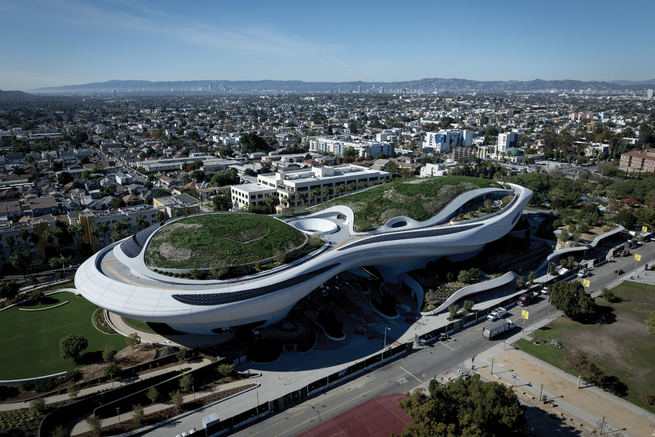
And now Lucas has built a temple to story. The Lucas Museum of Narrative Art, which opens this month in Exposition Park, just south of downtown Los Angeles, is a swooping(俯冲的;曲线优美的), brain-beggaring(令人难以置信的), super-sexy, twin-bodied leviathan(巨兽;庞然大物) of a megastructure, white as the gown of Princess Leia(《星球大战》中的莱娅公主), half spaceship, half cetacean(鲸类动物), all curves, Shangri-la(香格里拉:理想中的世外桃源) for skateboarders if they could ever get inside. Co-founded by Lucas and his wife, Mellody Hobson, it hoists(升起;吊起) itself into twinkling California emptiness on an 11-acre site (formerly two parking lots) next to the Natural History Museum and the L.A. Memorial Coliseum. Walking toward it, you think: Jesus. Eighth wonder? Squillion-dollar folly(愚蠢;荒唐事)? Architectural embodiment of some impulse from spiritus mundi(世界灵魂:宇宙的精神本源)? Entering it, you stop thinking altogether. As I passed from the dreamy light of the covered forecourt(前院;前庭), a single lens-like portal in its ceiling (for maximum diffraction(衍射) of heavenly tractor beams), and into the space-gobbling atrium, I was conscious only of a delighted vertigo(眩晕). Like, awe. Like, wow.
如今,卢卡斯建起了一座献给故事的圣殿。卢卡斯叙事艺术博物馆本月在洛杉矶市中心以南的博览公园开幕,是一座俯冲而下、令人脑洞大开、超级性感、双体巨兽般的巨型建筑,白得像莱娅公主的礼服,一半是飞船,一半是鲸鱼,全是曲线,对滑板少年来说简直是香格里拉——如果他们能进去的话。博物馆由卢卡斯和妻子梅洛迪·霍布森共同创办,在占地11英亩(原为两个停车场)的场地上拔地而起,毗邻自然历史博物馆和洛杉矶纪念体育场,耸入闪烁的加州虚空。走向它时,你会想:天哪。第八大奇迹?天价蠢事?还是“世界灵魂”某种冲动的建筑化身?走进去,你就不再思考了。当我从有顶前庭那梦幻般的光线中穿过——前庭天花板上有一个透镜般的开口(为了最大程度地衍射天堂的牵引光束)——进入吞噬空间的中庭时,我只感到一种愉悦的眩晕。就像,敬畏。就像,哇。