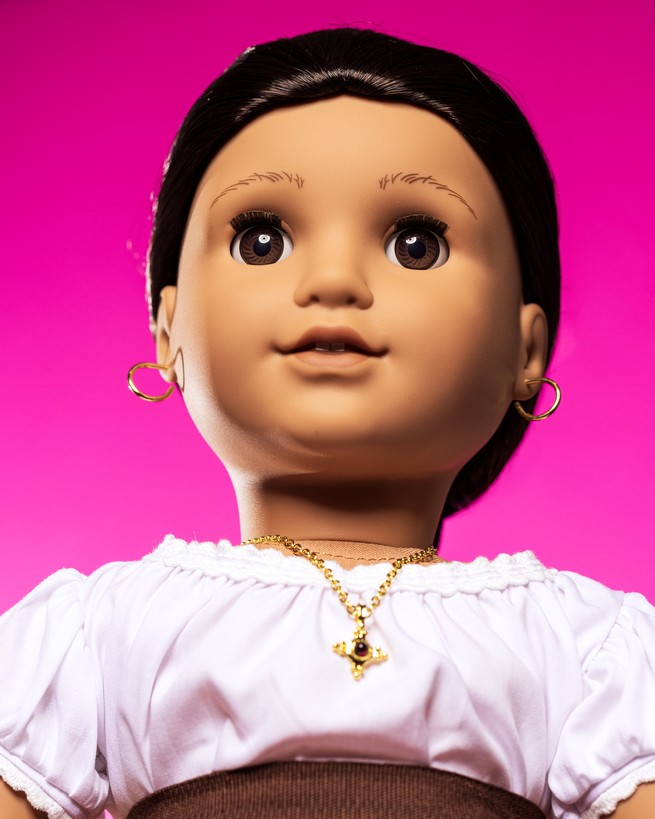
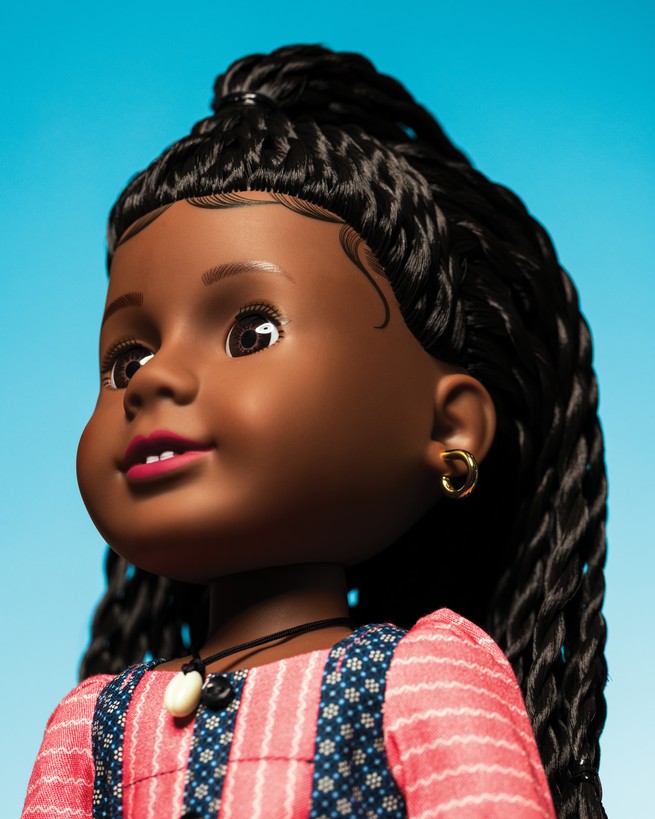
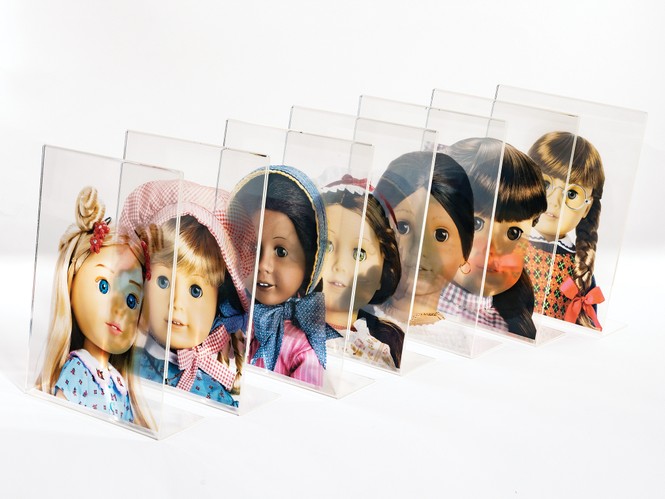
In the early 1990s, when I was in elementary school, a fancy catalog would arrive in the mailbox of our 1950s split-level(错层式住宅) in Philadelphia four times a year, and I’d hurry to my room to pore over(仔细研读) its elaborate spread(跨页版面)s. Tea caddies, Windsor chairs, writing quills, ice-cream churns. We didn’t have any antiques in our home, but the lure of the past was so strong that sometimes my sisters, five and seven years older than me, crammed onto my bed to dog-ear the pages too.(我们家没有古董,但过去的魅力如此之大,以至于有时比我大五岁和七岁的姐姐们也会挤到我的床上,把书页折角。) Most of all, we looked forward to checking in with the girls arrayed there, whose stories we knew so well: Samantha, Molly, Kirsten, Felicity, Addy, and, later in the decade, Josefina.
上世纪90年代初,我还在上小学。每年四次,一本精美的目录册会送到我们位于费城、建于50年代错层式住宅的邮箱里,我总会匆匆跑回房间,细细翻阅那些精美的跨页。茶叶罐、温莎椅、书写羽毛笔、冰淇淋搅拌器。我们家没有任何古董,但过去的魅力如此之大,有时比我大五岁和七岁的姐姐们也会挤到我的床上,把书页折角。最重要的是,我们期待看到那里陈列的女孩们,她们的故事我们耳熟能详:萨曼莎、莫莉、柯尔斯滕、费利西蒂、艾迪,以及后来十年出现的约瑟菲娜。
They were the American Girl dolls, preadolescent(青春期前的)s just slightly older than me, and I was enthrall(使着迷)ed by the pictures of their period(历史时代的) dresses, tiny school supplies, and exotic waxed lunch foods. My own doll was the farm girl Kirsten Larson, a Swedish immigrant to 1850s Minnesota. She had come in a burgundy(酒红色) box, with a slim book titled Meet Kirsten tucked in beside her. I promptly begged for the five other Kirsten books; the historical-fiction series followed the same pattern for each doll, ushering her through a year’s worth of life events, tailor(量身定制)ed to her personality and time and place. I remember playing with Kirsten in the backyard and having her trace out symbols in the dirt, just as she did with her new friend, a Dakota girl called Singing Bird, in the second book, Kirsten Learns a Lesson.(我记得在后院和柯尔斯滕玩耍,让她在泥土里画出符号,就像她在第二本书《柯尔斯滕学到一课》中与新朋友——一个叫“唱歌鸟”的达科他女孩——所做的那样。) To have such a doll was to own a whole world and the narratives within it.
她们就是美国女孩娃娃,这些前青春期女孩只比我稍大一点,我着迷于她们那个时代的裙子、微小的学习用品和充满异域风情的蜡封午餐食品的图片。我自己的娃娃是农场女孩柯尔斯滕·拉森,一个1850年代移民到明尼苏达的瑞典人。她装在一个酒红色的盒子里,旁边塞着一本薄薄的书,书名是《遇见柯尔斯滕》。我立刻央求买下另外五本柯尔斯滕的书;这个历史小说系列对每个娃娃都遵循同样的模式,引领她经历一年中的人生大事,并根据她的性格、时代和地点量身定制。我记得在后院和柯尔斯滕玩耍,让她在泥土里画出符号,就像她在第二本书《柯尔斯滕学到一课》中与新朋友——一个叫“唱歌鸟”的达科他女孩——所做的那样。拥有这样一个娃娃,就等于拥有一个完整的世界及其中的故事。
In my blue-collar(蓝领的) neighborhood, we lucky doll owners felt that our Boomer(婴儿潮一代) parents had entrust(托付)ed us with a valuable possession, and they had. When they were first introduced, in 1986, American Girl dolls cost a shocking $68 (roughly $208 today). Almost every Millennial I know who once spent hours with her American Girl doll has kept it, lovingly, into adulthood.(我认识的几乎每一个曾花数小时与她的美国女孩娃娃相伴的千禧一代,都深情地将其保存到了成年。)
在我所在的蓝领社区,我们这些幸运的娃娃拥有者觉得,我们婴儿潮一代的父母把一件珍贵的财产托付给了我们,而他们确实如此。1986年首次推出时,美国女孩娃娃售价高达68美元(约合今天的208美元),令人咋舌。我认识的几乎每一个曾花数小时与她的美国女孩娃娃相伴的千禧一代,都深情地将其保存到了成年。