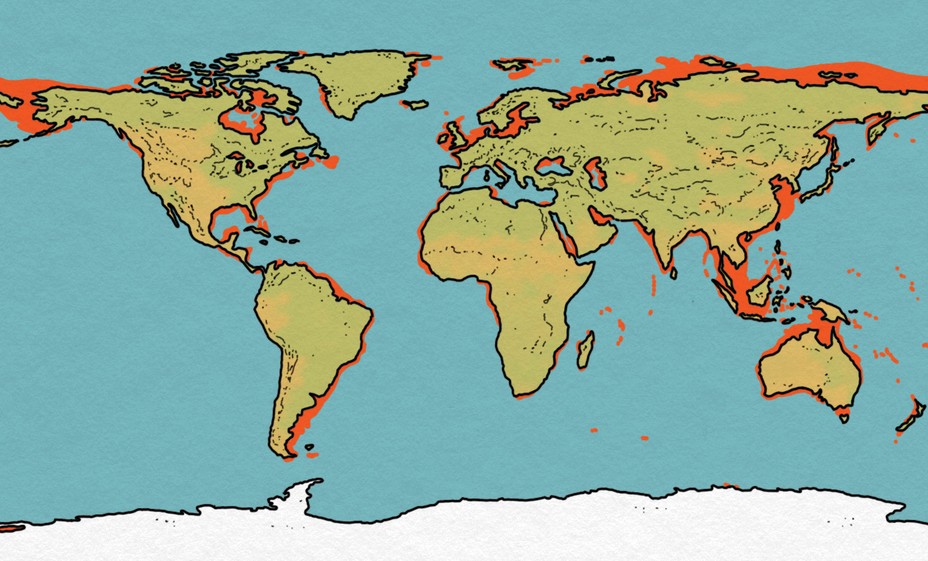
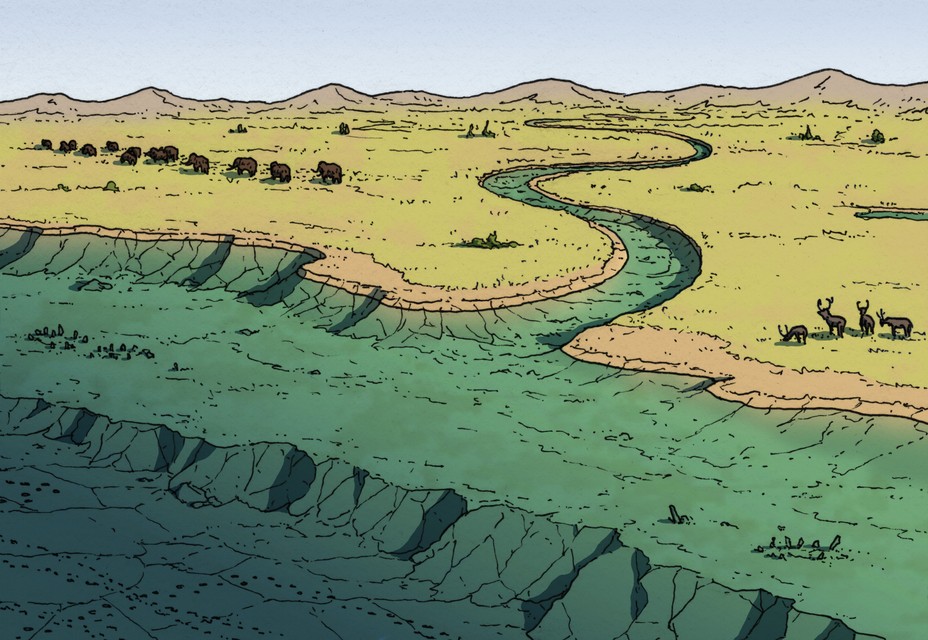
Imagine a planet that’s home not only to the seven continents you know but also to an immense feature you’ve never heard of, continental(大陆的;大陆性的) in scale. Extending along the world’s coastal shelves from the tropics almost to the poles, this place is roughly equivalent in size to South America, with a total area of more than 6.6 million square miles. During the last Ice Age, it consisted almost entirely of lowland ecosystems: cold grasslands and tundras in the far north, grazed by woolly mammoths and steppe bison; temperate woodlands and open country in the middle latitudes, home to aurochs, horses, and giant elk; tropical forests, grasslands, and mangrove swamps near the equator, inhabited by Stegodons, Asian hippos, and Komodo dragons; and dry scrub in the far south, roamed by marsupial lions, giant flightless birds, and lizards the size of crocodiles.(在最近一次冰期,它几乎完全由低地生态系统组成:最北部是寒冷的草原和苔原,长毛猛犸象和草原野牛在此吃草;中纬度地区是温带林地和开阔原野,原牛、马和巨型麋鹿栖息于此;赤道附近是热带森林、草原和红树林沼泽,剑齿象、亚洲河马和科莫多巨蜥生活其中;最南部是干燥的灌木丛,袋狮、巨型不会飞的鸟类和鳄鱼大小的蜥蜴在此游荡。) Great rivers, fed by an abundance of lakes and smaller streams, cut their way through(开辟道路穿过) many of these lowlands, eventually opening out into marshes, lagoons, estuaries, and tidal flats as they approached the coast.
想象一个星球,它不仅拥有你所熟知的七大洲,还拥有一个你从未听说过的巨大特征,其规模堪比大陆。这个地方沿着世界海岸架从热带一直延伸到接近极地,面积大致相当于南美洲,总面积超过660万平方英里。在最近一次冰期,它几乎完全由低地生态系统组成:最北部是寒冷的草原和苔原,长毛猛犸象和草原野牛在此吃草;中纬度地区是温带林地和开阔原野,原牛、马和巨型麋鹿栖息于此;赤道附近是热带森林、草原和红树林沼泽,剑齿象、亚洲河马和科莫多巨蜥生活其中;最南部是干燥的灌木丛,袋狮、巨型不会飞的鸟类和鳄鱼大小的蜥蜴在此游荡。众多河流由丰富的湖泊和小溪供水,穿过许多这样的低地,最终在接近海岸时展开为沼泽、潟湖、河口和潮滩。
Imagine that human beings settled this place after migrating out of Africa. As they disperse(分散,散开)d, they developed technologies and vessel(船;容器)s that allowed them to travel by sea; they devised hunting and fishing techniques that allowed them to accumulate surplus(剩余,过剩)es of food and establish small permanent settlements; they buried their dead, built monumental(纪念性的;巨大的) structures, and organized themselves into social hierarchies. It may have been here, in fact—millennia before the rise of ancient Mesopotamia and Egypt—that many of the developments we associate with “civilization” first occurred.(事实上,可能正是在这里——比古美索不达米亚和埃及的崛起早数千年——我们与“文明”联系在一起的许多发展首次出现。) But then imagine this: Some 20,000 years ago, these lands began to flood, and by 6,000 years ago, they had disappeared entirely, taking with them much of the story of our past.
想象人类在迁出非洲后定居于此。随着他们分散开来,他们发展出技术和船只,使他们能够海上航行;他们发明了狩猎和捕鱼技术,使他们能够积累多余的食物并建立小型永久定居点;他们埋葬死者,建造纪念性建筑,并将自己组织成社会等级。事实上,可能正是在这里——比古美索不达米亚和埃及的崛起早数千年——我们与“文明”联系在一起的许多发展首次出现。但接着想象这一点:大约2万年前,这些土地开始被洪水淹没,到6000年前,它们已完全消失,带走了我们过去的许多故事。
As it happens, there really is such a place. You’ve almost certainly been there yourself. It has even been given a name—and, no, it’s not Atlantis(亚特兰蒂斯(传说中沉没的岛屿)). It’s Aquaterra.
碰巧的是,确实存在这样一个地方。你几乎肯定去过那里。它甚至被赋予了一个名字——不,不是亚特兰蒂斯。它叫阿夸特拉。