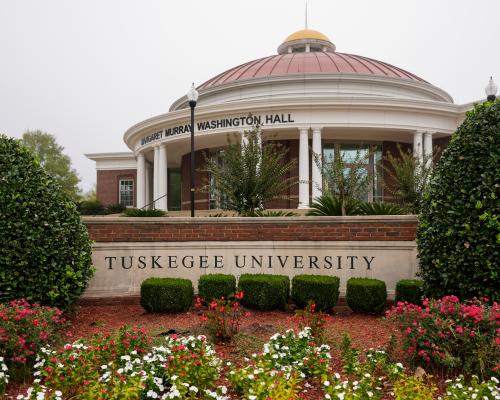
In anticipation(预期,预料) of the coming school year, the president of Tuskegee University, Dr Mark A Brown, sent welcome letters to students and their parents last month. Part of the message focused on the university’s policy for student attire(服装,衣着). A newly enforced dress code prohibit(禁止,阻止)s students from wearing “revealing(暴露的,袒胸露背的) clothing in class, to the cafeteria or in official settings like Convocation. They are also not able to wear bedroom shoes, bonnets, or durags to class or the cafeteria.” Dr Brown goes on to let the students know: “Faculty will be empower(授权,使能够)ed to respond to students who are inappropriately dressed based on these guidelines.”
为迎接新学年的到来,塔斯基吉大学校长马克·A·布朗博士上个月向学生及其家长发送了欢迎信。信中部分内容聚焦于大学的着装政策。一项新执行的着装规范禁止学生“在课堂、食堂或毕业典礼等正式场合穿着暴露的服装。他们也不能穿着卧室拖鞋、戴着发网或杜拉格头巾进入教室或食堂。”布朗博士接着告知学生:“教师将有权根据这些准则对穿着不当的学生作出回应。”
The policy has produced polarized(两极分化的) responses. Supporters believe that since the university is a private school, and Historically Black Colleges and Universities (HBCUs) have often been places where Black people learn discipline and earn entrance into the professional world, this dress code is simply reinforcing a tradition that calls for students to exhibit professionalism during their training. It harkens back to(使人回想起,追溯至) WEB DuBois’s idea of a “Talented Tenth”, which would consist of upwardly mobile(向上流动的,有晋升趋势的) Black leaders such as teachers and other professionals whose example of hard work and social standing would uplift(提升,振奋) the entire race.
这项政策引发了截然不同的反应。支持者认为,由于该大学是一所私立学校,而传统黑人大学(HBCUs)常常是黑人学习纪律、获得进入职业世界资格的地方,因此这项着装规范只是在强化一种传统,即要求学生在训练期间表现出专业素养。这让人想起W.E.B.杜波依斯提出的“十分之一精英”理念,即由向上流动的黑人领袖组成,如教师和其他专业人士,他们勤奋工作和较高社会地位的榜样将提升整个种族。
Dissenters like me largely concede(承认,让步) that as a private HBCU, Tuskegee has the institutional authority to require dress codes, as any similarly situated institution does. But we believe the policy is ultimately rooted in(植根于,源于) politics of respectability(体面政治), a set of assumptions I’ve grappled with throughout my own academic career. One of the damaging implication(可能的影响,含义)s of such a dress code is the reinforcement of anti-Black standards that have been externally and internally impose(强加,强制实行)d on Black people in the United States for decades and have never equal(等于,比得上)ed success or safety.
像我这样的反对者基本承认,作为一所私立传统黑人大学,塔斯基吉大学拥有制定着装规范的机构权力,任何类似地位的机构也是如此。但我们认为,这项政策最终植根于“体面政治”,即一套我在整个学术生涯中一直在努力应对的假设。这种着装规范的破坏性影响之一是强化了反黑人的标准,这些标准几十年来被外部和内部强加给美国黑人,却从未带来成功或安全。