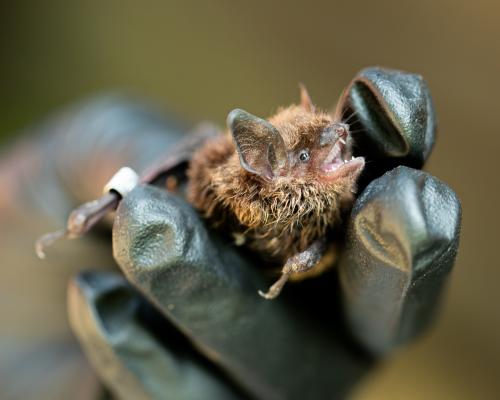
Crawling through a narrow passage in a cave beneath a boreal(北方的,北部森林的) forest near Fort Smith in Canada’s Northwest Territories in May, two biologists spotted a lifeless bat on a limestone ledge, its body covered in(被……覆盖) a spindly(细长的,纤弱的) white fungus.
五月,在加拿大西北地区史密斯堡附近的一片北方森林下的洞穴中,两位生物学家爬过狭窄的通道,在一块石灰岩壁上发现了一只毫无生气的蝙蝠,它的身上覆盖着一层细长的白色真菌。
When they shone their headlamps to get a closer look, they saw another bat with the fungus on its forearms(前臂). “It hissed(发出嘶嘶声) at us and crawled back into a crack,” Jesika Reimer says.
当他们打开头灯凑近看时,发现另一只蝙蝠的前臂上也长有真菌。“它朝我们发出嘶嘶声,然后爬回了一条裂缝中,”杰西卡·赖默说。
For Reimer, an ecologist specialising(专门研究,专攻) in bat populations in northern Canada and Alaska, there was little doubt. For 20 years, white-nose syndrome, a lethal(致命的) disease caused by the fungus Pseudogymnoascus destructans(一种致命真菌,导致白鼻综合征) (known as(被称为,称为) Pd), has swept(席卷,横扫) west across North America, spreading from bat to bat and cave to cave, killing more than 6.7 million bats.
对于专门研究加拿大北部和阿拉斯加蝙蝠种群的生态学家赖默来说,这几乎毫无疑问。20年来,由真菌 Pseudogymnoascus destructans(简称Pd)引起的致命疾病白鼻综合征,已从北美东部向西蔓延,在蝙蝠之间和洞穴之间传播,已导致超过670万只蝙蝠死亡。