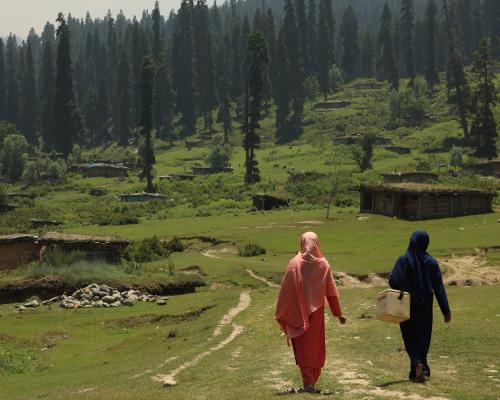
Before sunrise, Shameema slips on(迅速穿上) her worn rubber sandals and checks the insulated(隔热的,保温的) box – the ice packs inside must maintain the crucial cold chain(冷链(疫苗运输中的低温保存系统)) at between 2C and 8C (35.6-46.4F). She hoists(举起,扛起) the container on one shoulder and steps out into the dark.
日出之前,沙米玛穿上破旧的橡胶凉鞋,检查保温箱——里面的冰袋必须维持关键的冷链,温度保持在2至8摄氏度(华氏35.6至46.4度)。她把箱子扛上肩头,走进黑暗之中。
Tanzeela follows with her own pack, after quickly retying(重新系(鞋带)) the laces of her canvas(帆布) shoes. Both women live in Pulwama, a district where summer temperatures climb to 37C. Their destination lies higher, out of the valley where asphalt(柏油,沥青) turns to dirt track(土路,泥路) and then to a barely distinguishable(几乎难以辨认的) footpath along the floor of the mountain pine forests.
坦齐拉迅速重新系好帆布鞋的鞋带,背着自己的背包紧随其后。两人都住在普尔瓦马,那里夏季气温可攀升至37摄氏度。她们的目的地更高,在山谷之外,柏油路变成土路,再变成山间松林地面上几乎难以辨认的小径。
Shameema, 45, has worked as a vaccinator(疫苗接种员) for more than a decade, while Tanzeela, 28, joined the programme three years ago. They form part of India’s army of 2.5 million frontline health workers(一线卫生工作者) – the human machinery(人力机器(比喻大量人员构成的体系)) behind the world’s largest immunisation(免疫接种) campaign.
45岁的沙米玛担任疫苗接种员已超过十年,而28岁的坦齐拉三年前加入该项目。她们是印度250万一线卫生工作者大军中的一员——这是全球最大免疫接种运动背后的人力机器。