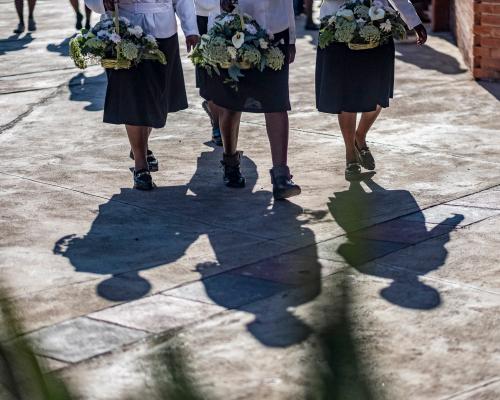
The three white coffins were draped(覆盖,披上) in white lace and topped with small sprays of flowers. The mourners who filled a Bulawayo church last week to pay their respects to Zandile Tshuma and her daughters, Natalie, 15, and Nala, five, had not engaged in the usual tradition of first viewing the dead at their home: the bodies of this family had travelled all the way from England to reach their final resting place at Luveve cemetery on the edge of Zimbabwe’s second city, in Matabeleland.(哀悼者没有遵循传统,因为遗体从英国运回。)
三口白色棺材上覆盖着白色蕾丝,顶端摆放着小束鲜花。上周,挤满布拉瓦约一座教堂的哀悼者们前来向赞迪莱·楚马及其女儿——15岁的娜塔莉和5岁的娜拉——表达敬意,他们并没有遵循通常先在家中瞻仰遗体的传统:这家人遗体从英格兰一路运回,最终安息在津巴布韦第二大城市边缘的马塔贝莱兰省卢韦韦公墓。
While the deaths attracted few news reports in the UK, in Zimbabwe and South Africa, the tragic case has reignited(重新点燃,再次引发) concern over the region’s high rates of femicide(杀害女性,女性谋杀). Many commentators on TV and social media expressed shock that(表示震惊) a well-educated woman with a successful career abroad seemed as vulnerable(脆弱的,易受伤害的) to familial violence as a poorer woman in a southern African township.
尽管这起死亡事件在英国鲜有新闻报道,但在津巴布韦和南非,这起悲剧重新引发了人们对当地高发女性谋杀问题的担忧。许多电视和社交媒体评论员表示震惊:一位受过良好教育、在国外事业有成的女性,似乎和南非乡镇中较贫穷的女性一样容易遭受家庭暴力。
Tshuma’s elderly parents were at the gravesides(墓地旁,坟边). The father, in a blue suit and clutching(紧握,抓住) a wooden cane, and her mother, in the black-and-white uniform of her church’s elders, sat in silence(默然坐着). Never Mpofu, 44, a neighbour, was taught at primary school by Tshuma’s mother. He says he was saddened(使悲伤,感到悲痛) by the violent way the family had been killed.
楚马年迈的父母在墓地旁。父亲穿着蓝色西装,紧握着一根木拐杖;母亲穿着教会长老的黑白制服,他们默然坐着。44岁的邻居内维尔·姆波夫曾在上小学时受教于楚马的母亲。他说,这家人被残忍杀害的方式让他感到悲痛。