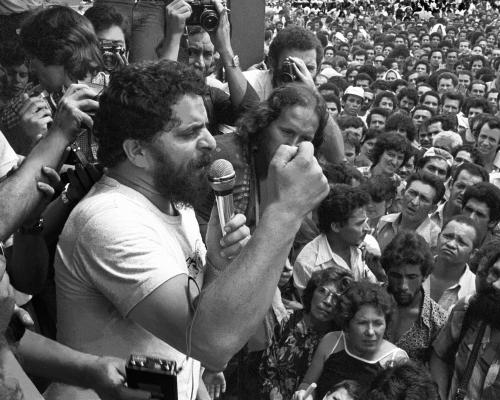
Day after day, tens of thousands of metalworkers would cram(挤满,塞满) on to the football pitch in São Paulo’s industrial suburbs to demand higher wages and, perhaps unwittingly(不知不觉地,无意中), transform the destiny of Brazil.
日复一日,数以万计的金属工人涌入圣保罗工业郊区的足球场,要求提高工资,并且,也许在不经意间,改变了巴西的命运。
“You weren’t just documenting a fact – you were documenting history(记录历史),” said photographer Jesus Carlos, who immortalise(使不朽,使永存)d the now legendary strikes of 1979 and 1980 with his 24mm lens.
“你不只是在记录一个事实——你是在记录历史,”摄影师热苏斯·卡洛斯说道,他用他的24毫米镜头定格了如今已成为传奇的1979年和1980年的罢工。
As Carlos snapped the sea of downtrodden but tenacious labourers, he remembers sensing the momentous nature of their challenge to Brazil’s military dictatorship, whose foot soldiers would surround the Vila Euclides stadium wielding truncheons and guns.(当卡洛斯拍摄那群饱受压迫却坚韧不拔的工人时,他记得自己感受到了他们对巴西军事独裁统治挑战的重大意义,独裁政权的士兵们会挥舞着警棍和枪支包围维拉欧克利迪斯体育场。)
当卡洛斯拍摄那群饱受压迫却坚韧不拔的工人时,他记得自己感受到了他们对巴西军事独裁统治挑战的重大意义,独裁政权的士兵们会挥舞着警棍和枪支包围维拉欧克利迪斯体育场。