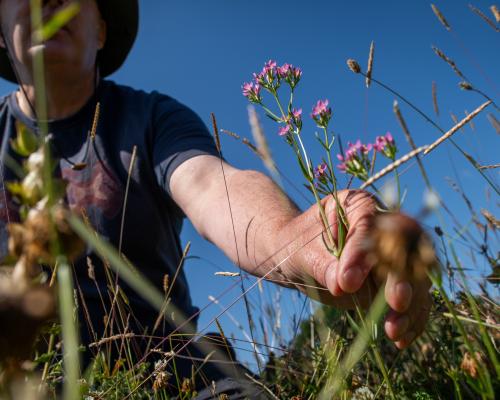
Tucked away on a country lane, a small field bursts with(充满,绽放) yellow and pink flowers. Quail and whitethroats(白喉莺(一种鸟)) call from the thick hedges and the plants, including common centaury(普通百金花(植物)), yellow rattle(黄花鼠尾草(植物)) and marsh and common spotted orchids, bounce with hoverflies(食蚜蝇) and butterflies.
在一条乡间小路的隐蔽处,一块小田里开满了黄粉相间的花朵。鹌鹑和白喉莺在茂密的树篱中鸣叫,植物——包括普通百金花、黄花鼠尾草、沼泽兰和普通斑点兰——随着食蚜蝇和蝴蝶的飞舞而摇曳。
More than 150 plant species have been recorded(记录,记载) on Sayer’s Old Meadow, in north Norfolk, England, which is remarkable when there was just one – oilseed rape(油菜(作物)) – growing there 21 years ago.
在英格兰诺福克郡北部的塞耶老草地,已记录到超过150种植物,这很了不起,因为21年前那里只生长着一种植物——油菜。
This transformation has happened without sowing any commercial wildflower mixes or making any other expensive interventions(干预措施) such as(例如,诸如) deep ploughing(犁地,耕作) or top-soil removal(去除表土), often undertaken when arable land is “restored” to nature-rich meadow. Instead, the four-acre field was simply cut for hay once every summer, with an abundance of wildflowers naturally – and rather mysteriously – finding their way into(自行进入,自然到达) the field.
这一转变的发生没有播种任何商业野花混合种子,也没有进行其他昂贵的干预措施,如深耕或去除表土——这些措施在耕地“恢复”为富饶的自然草地时经常采用。相反,这块四英亩的田地只是每年夏天割一次草,大量野花自然而然地——而且相当神秘地——进入了这片田地。