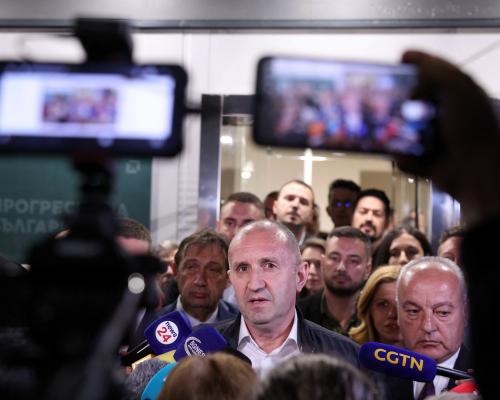
One evening nine years ago in the Bulgarian town of Balgari, a Brazilian tourist approached(走近,靠近) the casually dressed, middle-aged man surrounded by(被…包围) bodyguards, bystanders(旁观者,看热闹的人) and photographers. “Why are you important?” she asked. “I’m not so important,” he replied. She repeated the question and he admitted(承认(尤指不情愿地)): “I’m the president.”
九年前的一个晚上,在保加利亚的巴尔加里镇,一位巴西游客走近一名穿着随意、被保镖、旁观者和摄影师簇拥着的中年男子。“你为什么重要?”她问道。“我没那么重要,”他回答。她又问了一遍,他才承认:“我是总统。”
Now, in 2026, the rightwing populist(右翼民粹主义者) Rumen Radev is no longer the president, but the prime minister – the more powerful of the two positions – after his Progressive Bulgaria party secured an overwhelming majority(压倒性多数) in April’s election. While many in Europe breathed a sigh of relief(松了一口气) that month at the demise(垮台,终结) of Viktor Orbán in Hungary, others wondered if Radev would become the EU’s next disruptor-in-chief(首席搅局者).
如今已是2026年,右翼民粹主义者鲁门·拉德夫不再是总统,而是总理——这两个职位中权力更大的一个——此前他的“进步保加利亚”党在四月的选举中获得了压倒性多数。当欧洲许多人在那个月因匈牙利欧尔班的倒台而松了一口气时,另一些人则在想,拉德夫是否会成为欧盟的下一个“首席搅局者”。
His first months, analysts suggested, have pointed towards(指向,表明) a more transactional(交易性的,利益交换的) foreign policy with the US and Europe, and some initial moves(初步举动) that could be seen to benefit Russia.
分析人士认为,他执政的头几个月表明,他对美国和欧洲的外交政策更具交易性,而且一些初步举动可被视为有利于俄罗斯。