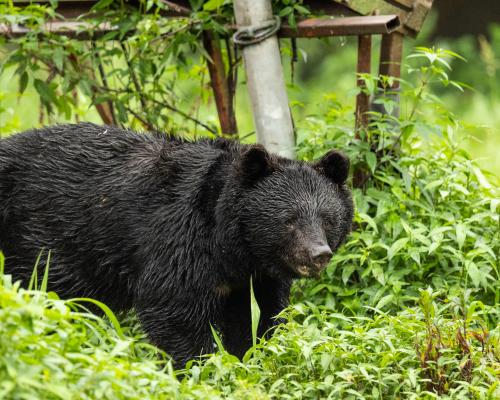
Every summer, millions of people escape the heat and humidity of Tokyo by heading to the tranquil(宁静的,平静的) resort town of Karuizawa in Japan’s Nagano prefecture – just an hour by bullet train from the capital. Here, at the foot of Mount Asama, visitors stroll bamboo-lined pathways, cycle in verdant(翠绿的,青翠的) highlands, and practise the wellness ritual of shinrin-yoku(森林浴(日本养生方式)), bathing among the cool hinoki forests. It would be the ideal nature retreat – if it wasn’t for the bears.(这里本该是理想的自然休养地——如果没有熊的话。)
每年夏天,数百万人逃离东京的炎热潮湿,前往日本长野县宁静的度假小镇轻井泽——距离首都仅一小时新干线车程。在这里,浅间山脚下,游客漫步于竹林小径,在翠绿的高地骑行,并践行“森林浴”这一养生仪式,在凉爽的桧木林中沐浴。这里本该是理想的自然休养地——如果没有熊的话。
From June to August, bears often move close to Karuizawa, feeding on the mulberries(桑葚), ants, leaves and cherry blossoms that grow near the town. Unlike nuts, these foods are low in calories, spurring the bears to seek out further sustenance(食物,营养). “They’re more likely to get close to residential(住宅的,居住的) spaces to see what they can find,” says Amelia Hiorns, a British zoologist who previously worked with Picchio Wildlife Research Centre in the town. “This combines with(与……结合,叠加) the busiest season for tourists.”
从六月到八月,熊经常靠近轻井泽活动,以小镇附近生长的桑葚、蚂蚁、树叶和樱花为食。与坚果不同,这些食物热量低,促使熊寻找更多的食物。“它们更有可能靠近居民区看看能找到什么,”英国动物学家阿米莉亚·希恩斯说,她曾在镇上的皮基奥野生动物研究中心工作。“这与旅游旺季叠加在一起。”
Picchio, a small Japanese conservation and nature education group, has been working to improve coexistence(共存,共处) between bears and people in Karuizawa and the surrounding region since the 1990s. Staff respond to reported bear sightings(目击事件) with one of their three Karelians – a dog breed trained in the western US to chase away bears. When dogs aren’t enough, the Picchio team tranquilises(使镇静,给……注射镇静剂) and relocates(重新安置,迁移) bears deep in the forest.
皮基奥是一个日本小型保护与自然教育组织,自20世纪90年代以来一直致力于改善轻井泽及周边地区熊与人的共存。工作人员接到熊出没的报告后,会带着他们的三只卡累利阿犬之一前去应对——这是一种在美国西部训练用来驱赶熊的犬种。当狗不够用时,皮基奥团队会给熊注射镇静剂,并将其重新安置到森林深处。