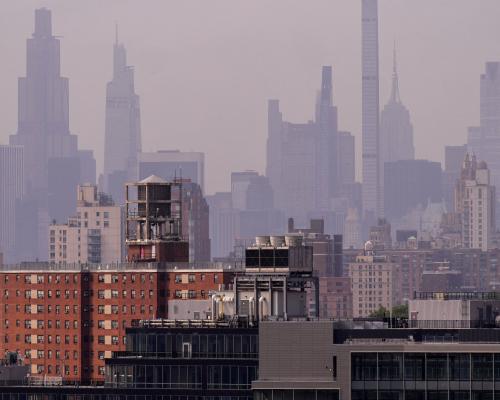
New York lawmakers are now trying to better protect residents from the deadly legionnaires’ disease(军团病,一种严重肺炎) by increasing regulations and inspections of cooling towers after two outbreak(爆发,突然发生)s of the infection over the last two summers and a raft of(大量的,一连串的) new lawsuits.
纽约立法者目前正试图通过加强对冷却塔的监管和检查,更好地保护居民免受致命的军团病侵害,此前两个夏天爆发了两次军团病疫情,并引发了一系列新的诉讼。
Legionnaires’ disease is a serious pneumonia(肺炎) caused by a bacterium(细菌(单数)) called legionella. It often comes from large air-conditioning systems, like those used in hotels, hospitals and high-rise buildings, because the cooling towers contain water to remove heat. If not well maintained, the liquid can foster the bacteria, which can then be swept into fans and circulated through the air.(如果维护不当,水可能滋生细菌,细菌随后可能被卷入风扇并通过空气循环传播。)
军团病是一种由名为军团菌的细菌引起的严重肺炎。它通常来自大型空调系统,如酒店、医院和高层建筑中使用的系统,因为冷却塔含有用于散热的水。如果维护不当,这些水可能滋生细菌,细菌随后可能被卷入风扇并通过空气循环传播。
“The thing about a cooling tower is that it’s not just the people in your building that are affected(冷却塔的问题在于,受影响的不仅仅是你们大楼里的人。),” said Amy Pruden, a professor of civil and environmental engineering at Virginia Tech University. “You can just be walking by this hotel or hospital or apartment building and happen to(碰巧,恰好) linger(逗留,徘徊) having a conversation or something and then you get exposed(暴露的,接触的).”
“冷却塔的问题在于,受影响的不仅仅是你们大楼里的人,”弗吉尼亚理工大学土木与环境工程教授艾米·普鲁登说。“你可能只是路过这家酒店、医院或公寓楼,碰巧逗留聊个天什么的,然后就被感染了。”