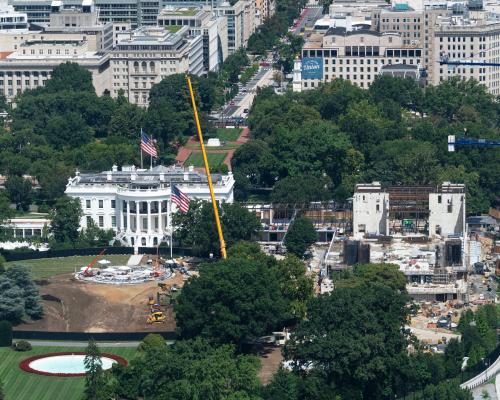
On Monday, a majority on the supreme court found a technical way to overrule(推翻,否决) a lower court’s imperative(命令,必要的事) to stop work, while not taking a stance on whether the whole enterprise might be illegal to begin with(首先,从一开始). Preservationists, the majority held, appear to lack legal grounds for filing a suit blocking Trump’s ballroom; that means construction will proceed, even if none other than John Roberts, in a dissent(异议,反对意见), held that “those responsible” were breaking the rules in deciding “what to build up at the People’s House”. The solicitor general(副检察长), John Sauer, is on record(公开记录在案) claiming that 65% of the project is completed (of course, he might have exaggerated – such things are known to have happened in Trump administrations). Either way, it is thus likely that there will be a massive structure next to the original White House; and, given that the ruling will embolden(使有胆量,鼓励) the president dramatically to change Washington DC’s landscape by spending money never approved by Congress, we might be cursed with a triumphal arch(凯旋门) as well. All of which raises the question: what to do with a monstrous architectural legacy in post-Trump America?(这一切都引出了一个问题:在特朗普之后的美国,如何处理这份庞大的建筑遗产?)
周一,最高法院多数法官找到了一种技术性手段,推翻了下级法院要求停止施工的命令,同时并未对整个工程从一开始是否违法表明立场。多数意见认为,保护主义者似乎缺乏法律依据来提起诉讼以阻止特朗普的舞厅建设;这意味着施工将继续进行,尽管恰恰是约翰·罗伯茨在反对意见中表示,“责任人”在决定“在人民之宫建造什么”时违反了规则。副检察长约翰·绍尔公开声称项目已完成65%(当然,他可能夸大了——众所周知,特朗普政府时期此类事情时有发生)。无论如何,白宫原址旁很可能会出现一座庞大的建筑;而且,鉴于这一裁决将极大地鼓舞总统,使其动用从未经国会批准的资金来改变华盛顿特区的面貌,我们或许还会不幸地看到一座凯旋门。这一切都引出了一个问题:在特朗普之后的美国,如何处理这份庞大的建筑遗产?
Some might dismiss(不予理会,驳回) the question as a bit of a luxury problem. After all, a war that also demonstrates the ongoing disempowerment(权力被剥夺) of Congress keeps dragging on; ICE(美国移民与海关执法局) continues its cruel day-to-day work; Trump is trying every tactic to make the midterms(中期选举) go his way(按他的意愿发展). But the built environment(建筑环境,人造环境), and especially the civic(城市的,公民的) landscape of a capital, is never just an afterthought(事后想法,马后炮). Buildings and monuments make values visible, as the philosopher Susan Neiman(美国哲学家,著有《向德国学习》) once put it. And the decision to leave Trump’s structures in place as if his reign had just been another normal era in US history is not neutral – just like leaving Confederate monuments(美国南部邦联纪念碑) in place is not neutral.
有些人可能会认为这个问题有点奢侈。毕竟,一场同时表明国会权力持续被削弱的战争仍在拖延;移民执法局继续其残酷的日常工作;特朗普正用尽一切手段让中期选举朝着有利于他的方向发展。但建筑环境,尤其是首都的市政景观,绝不仅仅是事后才想到的东西。正如哲学家苏珊·奈曼所说,建筑和纪念碑使价值观可见。而决定让特朗普的建筑原封不动,仿佛他的统治只是美国历史上又一个正常时期,这并非中立之举——就像保留邦联纪念碑并非中立一样。
For those who dismiss talk of civic values made visible as all too idealistic(理想主义的,不切实际的), there is another, hard-nosed(务实的,精明的) argument to consider: after all, for anyone around the globe ever to trust a US government again, Trumpism will need to be thoroughly repudiate(拒绝,否认,摒弃)d. Without a clear distancing from his toxic reign – during which the whims and obsessions of one evidently incompetent conman wreaked havoc with old alliances – other countries might well conclude that the US has failed to learn any lessons.(如果不与他的有毒统治明确划清界限——在统治期间,一个明显无能的骗子的心血来潮和执念对旧联盟造成了严重破坏——其他国家很可能会认为美国没有吸取任何教训。) And the built environment is a prime candidate(首要候选,最佳选择) for making that distancing visible to the outside world.
对于那些认为谈论“使价值观可见”过于理想化的人,还有另一个务实的论点值得考虑:毕竟,要让全球任何人再次信任美国政府,就必须彻底摒弃特朗普主义。如果不与他的有毒统治明确划清界限——在统治期间,一个明显无能的骗子的心血来潮和执念对旧联盟造成了严重破坏——其他国家很可能会认为美国没有吸取任何教训。而建筑环境是向外界展示这种划清界限的首要选择。