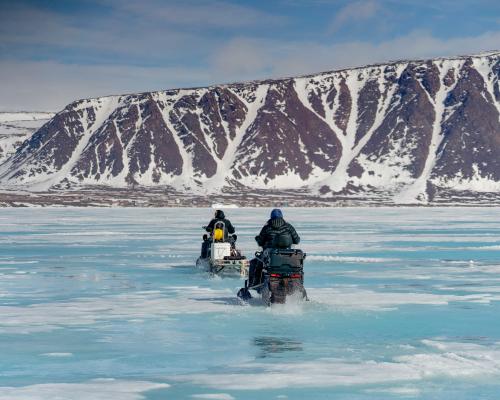
Electric-blue meltwater sprays up under Terry Noah’s snowmobile as he races across sea ice extending out from Canada’s northernmost public community: Grise Fiord in Nunavut, a hamlet of 144 people closer to Murmansk in Russia than the Canadian city of Toronto.(电蓝色的融水在诺亚的雪地摩托下飞溅,他正疾驰在从加拿大最北社区延伸的海冰上:努纳武特的格里塞菲约德,一个144人的小村庄,距离俄罗斯摩尔曼斯克比多伦多更近。) The bay’s cliffs loom(赫然出现) higher and higher like stone icebergs as he approaches his destination across the bay.
电蓝色的融水在特里·诺亚的雪地摩托下飞溅,他正疾驰在从加拿大最北的公共社区延伸出去的海冰上:努纳武特的格里塞菲约德,一个仅有144人的小村庄,这里距离俄罗斯的摩尔曼斯克比距离加拿大多伦多还要近。当他穿过海湾接近目的地时,海湾的悬崖像石质冰山一样越来越高大。
Noah pulls his sled carefully over a seal’s breathing hole, about the circumference(周长) of a basketball. Using a custom-made(定制的) winch(绞车), he lowers a submersible(可潜水的) instrument into the sea below the ice.
诺亚小心地拉着雪橇经过一个海豹的呼吸孔,这个孔大约有篮球的周长那么大。他用一个定制的绞车,将一个潜水仪器下放到冰层下的海中。
Noah will bring the data it collects back to his shipping container-based mobile lab and beam(发送(数据)) the data to the south, where his collaborator(合作者), research scientist Andrew Hamilton at the University of Alberta, can review it.
诺亚将把仪器收集到的数据带回他那个以集装箱为基础的移动实验室,并将数据发送到南方,他的合作者——阿尔伯塔大学的研究科学家安德鲁·汉密尔顿——可以在那里查看数据。