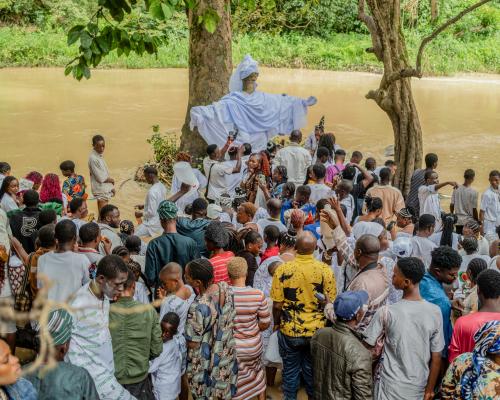
Devotees in white clothing line the riverbank(沿河岸排列), praying as they carry offerings of fruit, kola nut and sacrificial animals in supplication(恳求,祈求) to Osun, the Yoruba goddess of fertility, beauty and healing, whose carved form stands with arms outstretched a few metres away in the Osun River.
身穿白衣的信徒沿河岸排列,一边祈祷,一边手持水果、可乐果和祭祀动物作为供品,向奥孙——约鲁巴的生育、美丽与治愈女神——祈求。几米外的奥孙河中,矗立着双臂张开的奥孙雕像。
It is the final day of Nigeria’s annual Osun Osogbo festival in honour of the African deity, in a tradition that has existed for hundreds of years and draws people from across the diaspora.(这是尼日利亚一年一度的奥孙-奥索博节日的最后一天,该节日是为了纪念这位非洲神灵,这一传统已延续数百年,吸引着来自世界各地的侨民。)
这是尼日利亚一年一度的奥孙-奥索博节日的最后一天,该节日是为了纪念这位非洲神灵,这一传统已延续数百年,吸引着来自世界各地的侨民。
Except this year the water was once again a discoloured(变色的,褪色的) brown. Until 2018, the river ran clear(保持清澈), but then mining several miles upstream began to pollute it, introducing heavy metals and sediment(沉积物,沉淀物) into the watercourse.
但今年,河水再次变成了浑浊的棕色。直到2018年,这条河还清澈见底,但随后上游几英里处的采矿开始污染河流,将重金属和沉积物带入河道。