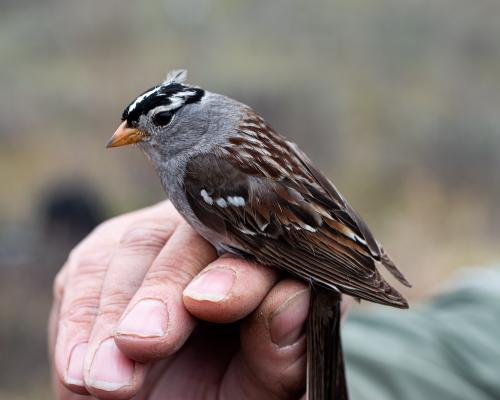
On Alaska’s North Slope, scientists tread carefully across clumps of tussock(丛生草) grasses toward a fast-flowing stream draining(排水;流经) the imposing(雄伟的) Brooks Range of ice and snow. Near Galbraith Creek, they string out(拉开、铺开) a mist net for white-crowned sparrows. The birds have recently arrived from southerly latitude(纬度)s, intent on feasting on the insects that will soon descend on(大批降临) the tundra like storm clouds.
在阿拉斯加北坡,科学家们小心翼翼地穿过一丛丛高草,朝一条湍急的溪流走去。这条溪流从雄伟的布鲁克斯山脉倾泻而下,裹挟着冰雪融水。在加尔布雷斯溪附近,他们张开雾网,捕捉白冠带鹀。这些鸟刚从南方纬度飞来,一心要大吃一顿即将像乌云般铺天盖地降临苔原的昆虫。
The Arctic summer is short-lived(短暂的), and sparrows have only a few weeks to establish territories(建立领地), find mates, lay eggs and raise their chicks on a steady diet of bugs. From every ensnared(被网住的) bird, the scientists collect blood, feather and faecal(粪便的) samples to see what they are eating and how that changes over the summer.
北极的夏天转瞬即逝,带鹀只有几周时间建立领地、寻找配偶、产卵,并用源源不断的虫子喂养雏鸟。科学家从每一只被网住的鸟身上采集血液、羽毛和粪便样本,以了解它们吃什么,以及这种食物构成在夏季如何变化。
One thing they want to know is whether the sparrows are consuming a lot of stream insects, such as stoneflies and mayflies, says Ian Shuman, a doctoral student in quantitative ecology(数量生态学) at Columbia University. As willow shrubs claim new territory along the Arctic’s rivers and streams – a process scientists call “shrubification(灌丛化)” – this could disrupt(打乱) the life cycles of stoneflies and mayflies. If the songbirds also depend on aquatic(水生的) insects to thrive, that might affect the sparrows’ prospects(前景).
哥伦比亚大学数量生态学博士生伊恩·舒曼说,他们想弄清楚的一件事是:带鹀是否大量捕食溪流昆虫,比如石蝇和蜉蝣。随着柳树灌丛在北极的河流溪畔开疆拓土——科学家称之为“灌丛化”——石蝇和蜉蝣的生命周期可能被打乱。如果这些鸣禽也依赖水生昆虫繁衍壮大,那么带鹀的前景就可能受到影响。