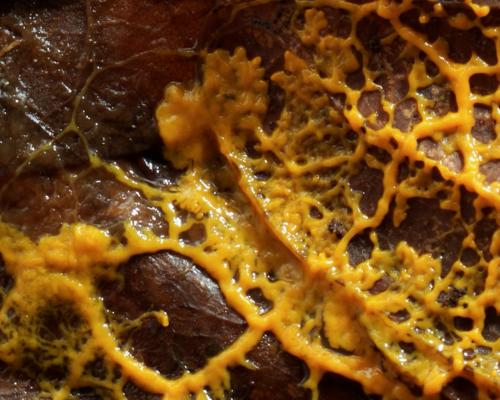
Forty years ago, as an undergraduate in Hokkaido, Toshiyuki Nakagaki came upon a lemon-yellow stain in a petri dish. That encounter turned him into a doyen(元老,泰斗) of slime mould research – and fed a storm of(引发了一场……风暴) biological and philosophical debate about the meanings of life and intelligence that persists to this day. Before, no one would have called a slime mould “intelligent”; the popular adjective, in fact, was “simple”. “A simple mass of protoplasm(原生质),” one 1895 description ran; “among the most simple of organisms”, said another. And it was hard to argue otherwise. A slime mould can appear to be just a small cell, capable only of feeding and reproducing. Simple is as simple does.(简单就是简单(做什么事就是什么东西)。)
四十年前,还是北海道大学本科生的中垣俊之在培养皿里发现了一块柠檬黄色的污渍。那次邂逅使他成为黏菌研究的泰斗,也引发了一场关于生命与智能含义的生物学和哲学大辩论,至今仍未平息。在此之前,没人会把黏菌称为“有智能”的;事实上,当时流行的形容词是“简单”。1895年的一份描述称其为“一团简单的原生质”;另一份则说它“属于最简单的生物之列”。而且很难反驳。黏菌看起来不过是一个小细胞,只能进食和繁殖。简单就是简单。
Of that first meeting, Nakagaki said: “I was just impressed with how fast it moved.” <em>Physarum polycephalum</em>, the slime mould species in that petri dish, has a top speed of 1cm an hour. For amoebic(变形虫的) organisms, that’s gold-medal standard(金牌水准). At first glance, <em>Physarum</em> seems to spread as irregularly as ink on blotting paper(吸墨纸), but in fact it senses its meals of bacteria or other microbes and reaches for them with a long, thin finger of protoplasm – which not only digests its food but then forage(觅食,搜寻)s further or pulls back into the rest of the mould. It’s impossible to watch a slime mould over many days without sensing some deliberation(深思熟虑,审慎) at play.
谈及那次初见,中垣说:“我只是惊叹于它移动的速度。”那个培养皿中的黏菌物种——多头绒泡菌(Physarum polycephalum)——最高时速为1厘米。对变形虫类生物而言,这已是金牌水准。乍看之下,绒泡菌似乎像墨水在吸墨纸上一样不规则地扩散,但实际上它能感知细菌或其他微生物组成的食物,并伸出一根细长的原生质手指去够取——这根手指不仅消化食物,还会继续觅食或缩回黏菌主体。连续多天观察黏菌,你不可能不感觉到某种“深思熟虑”在起作用。
<em>Physarum</em> is often found as a glistening patch creeping over leaf litter(落叶层) in forests; hence its nickname: “dog vomit mould(“狗呕吐霉”——黏菌的俗称)”. Even at its most expansive, occupying a couple of square metres, it is a single cell containing many nuclei(细胞核(复数)) – the tiny microdots holding its DNA. (Technically, this kind of structure is called a “syncytium(合胞体)”.) The fact that you can see it with the naked eye(用肉眼), and even perceive the swells and contraction(收缩)s of the protoplasm within, makes it ideal for experiments. So Nakagaki got to work.
绒泡菌常被发现为森林落叶层上爬行的一片闪亮斑块,因此得了个绰号:“狗呕吐霉”。即便在其最扩张的状态下,占据几平方米,它仍是一个含有许多细胞核的单细胞——那些微小的点状物承载着它的DNA。(严格来说,这种结构称为“合胞体”。)你可以用肉眼看到它,甚至能感知到内部原生质的膨胀与收缩,这使它成为理想的实验对象。于是中垣开始了工作。