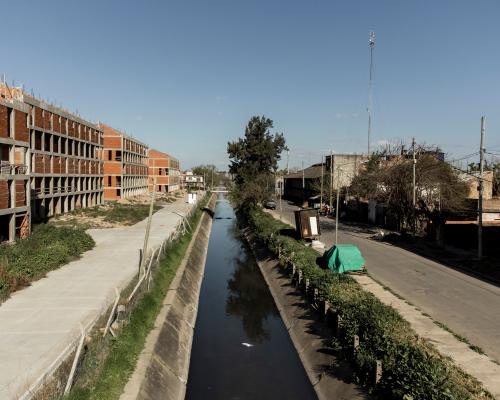
Twenty-three years ago, María Monges looked around her flooded(被洪水淹没的) neighbourhood and knew something had to be done(必须采取行动).
二十三年前,玛丽亚·蒙赫斯环顾被洪水淹没的社区,知道必须做点什么了。
Founded in 1998 in Buenos Aires province’s San Martín district, the community of Costa Esperanza sits on the banks of the Reconquista, Argentina’s second most-polluted river and owes its name to(名字来源于) the fictional location of a hit Argentine youth telenovela(电视小说,拉美肥皂剧) of the time, Verano del 98. But the real place is very different from the idyllic coastal city where the protagonists of Argentina’s answer to Dawson’s Creek met their first loves or sang around bonfires.(但现实中的这个地方与剧中那个田园诗般的海滨城市截然不同——在剧中,这部被誉为阿根廷版《恋爱时代》的电视剧的主角们在那里邂逅初恋,围着篝火唱歌。)
科斯塔埃斯佩兰萨社区于1998年在布宜诺斯艾利斯省的圣马丁区成立,坐落在雷孔基斯塔河畔——阿根廷污染第二严重的河流。社区的名字来源于当时一部热门阿根廷青春电视剧《98之夏》中的虚构地点。但现实中的这个地方与剧中那个田园诗般的海滨城市截然不同——在剧中,这部被誉为阿根廷版《恋爱时代》的电视剧的主角们在那里邂逅初恋,围着篝火唱歌。
“You don’t know what it was like – when we started cleaning up, all the streams were blocked up everywhere: rubbish, dead dogs … a bit of everything. It was unsanitary(不卫生的), but we carried on(继续) working anyway,” says Monges, now 61. She started knocking on doors(挨家挨户敲门), getting people out to work with her, and in 2005 got the provincial administration to give them tools, uniforms and training. Now Monges leads 9 de julio, a workers’ cooperative that, from Monday to Friday, cleans up streams flowing from the river.(如今蒙赫斯领导着“七月九日”工人合作社,每周一到周五清理从河里流出的溪流。) “Every day, we will find rubbish,” says Monges. “It’s like people don’t understand.”
“你不知道当时是什么样子——我们开始清理的时候,所有溪流都被堵住了:垃圾、死狗……什么都有。很不卫生,但我们还是继续干,”现年61岁的蒙赫斯说。她开始挨家挨户敲门,动员人们和她一起干活,并在2005年争取到省政府提供工具、制服和培训。如今蒙赫斯领导着“七月九日”工人合作社,每周一到周五清理从河里流出的溪流。“每天我们都会发现垃圾,”蒙赫斯说。“好像人们就是不明白。”