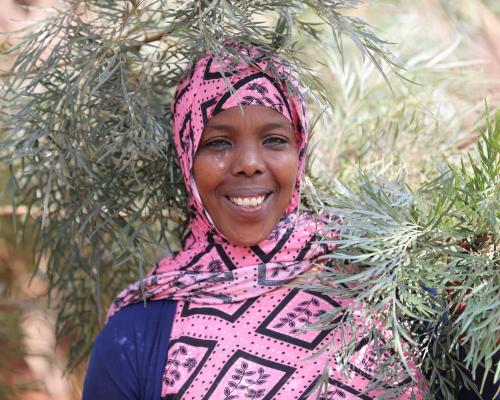
When Halima Kedir first began planting trees, she was met with scepticism(怀疑态度) and even mockery(嘲笑). “My neighbours discouraged me,” she recalls, sitting on a wooden chair in her garden, which is lush(茂盛的) with the trees and fruits she has planted – banana, olive and grevillea(银桦) among them.
哈利玛·凯迪尔刚开始种树时,迎接她的是怀疑甚至嘲笑。“邻居们都劝我别白费力气,”她回忆道,当时她坐在自家花园的木椅上,园子里她亲手栽下的树木和水果郁郁葱葱——其中有香蕉、橄榄和银桦。
“They thought I was striving for nothing, but with time, many are realising that trees can be part of the solution to our problems as a way to fight climate change and food insecurity,” she says.(“他们以为我在做无用功,但渐渐地,许多人开始意识到,树木可以成为解决我们问题的一部分——既能应对气候变化,也能缓解粮食不安全,”她说。)
“他们以为我在做无用功,但渐渐地,许多人开始意识到,树木可以成为解决我们问题的一部分——既能应对气候变化,也能缓解粮食不安全,”她说。
Kedir, 35, who lives in the Berbere district of Ethiopia’s Oromia region, became an accidental environmentalist after planting thousands of trees – she has lost count of how many – inspiring others to follow suit.(35岁的凯迪尔住在埃塞俄比亚奥罗米亚州的贝尔贝雷区。她种下数千棵树后——具体数目已记不清——无意间成了一名环保主义者,并激励他人效仿。)
35岁的凯迪尔住在埃塞俄比亚奥罗米亚州的贝尔贝雷区。她种下数千棵树后——具体数目已记不清——无意间成了一名环保主义者,并激励他人效仿。