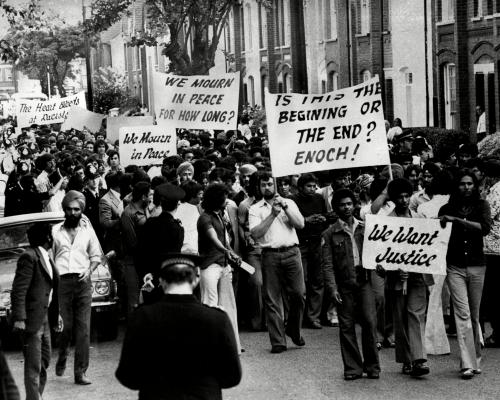
There it was: a pool of blood spreading across the pavement(人行道). A section of the high street had been cordoned off(被封锁、被隔离) and a uniformed police officer gestured for bystanders(旁观者、围观群众) to move along. It was the long hot summer(漫长炎热的夏天(多事之夏)) of 1976, and a racist murder had stunned(使震惊、使目瞪口呆) Southall in west London.
它就在那里:一摊血在人行道上蔓延开来。商业街的一段已被封锁,一名穿制服的警察示意围观者走开。那是1976年漫长炎热的夏天,一起种族主义谋杀案震惊了伦敦西部的索索尔。
“What has happened here, officers?” asked Suresh Grover, then a curious 22-year-old, later to be widely known as a leading racial justice activist(活动家、积极分子). “Go away, it’s just Indian blood,” was the response. Grover was soon to learn that 18-year-old Gurdip Singh Chaggar, an engineering student, had been stabbed to death by racist thugs the night before.(格罗弗很快得知,18岁的工程系学生古尔迪普·辛格·查格尔前一晚被种族主义暴徒刺死。)
“警官,这里发生了什么?”苏雷什·格罗弗问道。他当时22岁,充满好奇,后来成为广为人知的种族正义活动家。“走开,不过是印度人的血罢了。”对方这样回答。格罗弗很快得知,18岁的工程系学生古尔迪普·辛格·查格尔前一晚被种族主义暴徒刺死。
The late 1970s was the era of “Paki-bashing(“打巴基斯坦佬”——针对南亚裔的种族暴力)”: homes, shops and places of worship were attacked, while south Asians – young and old – were murdered on the streets. That day, Grover acted instinctively(本能地、出于直觉地), taking some paint and daubing(涂抹、乱涂) the pavement near the blood with the words: “This racist murder will be avenged(被报复、得到雪耻). We’ll get you racist scum(渣滓、人渣).”
20世纪70年代末是“打巴基斯坦佬”的时代:住宅、商店和礼拜场所遭到袭击,南亚裔——无论老少——在街头被杀害。那天,格罗弗本能地行动起来,拿来一些油漆,在血迹旁的人行道上涂下这样一句话:“这起种族主义谋杀必将得到报复。我们饶不了你们这些种族主义渣滓。”