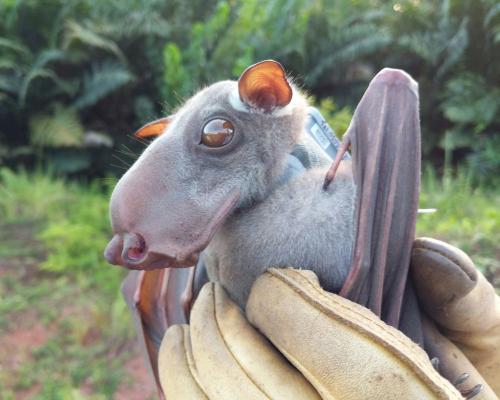
In the northern forests of the Congo-Brazzaville, as the sun slips away, a distinctive honking(鸣叫声) fills the dusky sky. Every evening, thousands of hammer-headed fruit bats depart their daytime roosts in search of mates, calling out through large, box-shaped snouts that give the flying mammals the appearance of a winged moose.(每天傍晚,成千上万只锤头果蝠离开白天的栖息地外出寻找配偶,它们通过巨大的箱形吻部发出叫声,这种外形让这些会飞的哺乳动物看起来像长着翅膀的驼鹿。) Here, along the Congo River, scientists have been collecting DNA swabs(拭子) and tissue samples from the bats for years, working deep into the night in spacesuit-like protective gear(防护装备).
在刚果(布)北部的森林里,夕阳西沉,一种独特的鸣叫声响彻暮色中的天空。每天傍晚,成千上万只锤头果蝠离开白天的栖息地外出寻找配偶,它们通过巨大的箱形吻部发出叫声,这种外形让这些会飞的哺乳动物看起来像长着翅膀的驼鹿。多年来,科学家一直在刚果河沿岸采集蝙蝠的DNA拭子和组织样本,他们身穿类似宇航服的保护装备,工作到深夜。
Those hard-won samples are now among the thousands of specimens gathered from bats across the world that have helped to reshape what we know about the bat family tree.(这些来之不易的样本如今已成为从世界各地蝙蝠身上采集的数千份标本的一部分,它们帮助重塑了我们对蝙蝠演化谱系的认知。)
这些来之不易的样本如今已成为从世界各地蝙蝠身上采集的数千份标本的一部分,它们帮助重塑了我们对蝙蝠演化谱系的认知。
In a landmark study published today in the journal Nature, a team of more than 130 international researchers combed through ancient bat fossils and genomic data from living species to establish that bats likely originated in Europe about 65m years ago – not in Africa, Asia or North America, as had previously been thought.(在一项发表于今日《自然》杂志的里程碑式研究中,一支由130多名国际研究人员组成的团队梳理了古代蝙蝠化石和现存物种的基因组数据,最终确认蝙蝠很可能约6500万年前起源于欧洲——而非此前认为的非洲、亚洲或北美。)
在一项发表于今日《自然》杂志的里程碑式研究中,一支由130多名国际研究人员组成的团队梳理了古代蝙蝠化石和现存物种的基因组数据,最终确认蝙蝠很可能约6500万年前起源于欧洲——而非此前认为的非洲、亚洲或北美。