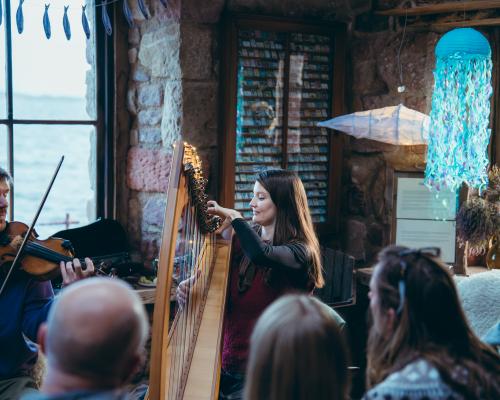
Inside a bothy(小屋,简易住所) overlooking the Summer Isles, in the north-west of Scotland, the lilting(抑扬顿挫的,轻快悦耳的) tones of a traditional Gaelic duo fill a room full of musicians, storytellers, artists, local people and reveller(狂欢者,欢宴者)s, hung with fish-shaped lanterns and “Happy Birthday” signs.
在苏格兰西北部一间俯瞰夏日群岛的小屋里,一支传统盖尔语二重奏的悠扬乐声回荡在房间中,屋里挤满了音乐家、讲故事的人、艺术家、当地居民和狂欢者,墙上挂着鱼形灯笼和“生日快乐”的标语。
It’s no ordinary birthday. The people in the small cabin have come together, on a windy night in Achiltibuie, a string of coastal hamlet(小村庄)s and villages north of Ullapool, to celebrate an important milestone in the community’s history: a hard-won(来之不易的) battle to protect their waters from the ravages(破坏,蹂躏) of scallop dredging(扇贝底拖网捕捞).
这不是一个普通的生日。在这个风大的夜晚,阿赫蒂尔布伊(Achiltibuie,乌拉浦以北一连串沿海小村和村庄)的小木屋里,人们聚在一起,庆祝社区历史上一个重要的里程碑:一场来之不易的胜利——保护他们的水域免受扇贝拖网捕捞的蹂躏。
The coastline here, a metallic grey seen through the bothy’s windows, is dotted with beds of one of the UK’s most biodiverse and carbon-rich habitats, a 9,000-year-old pink seaweed called maerl, two of which are a mile long.(这里的海岸线,从小屋窗户望去呈金属灰色,点缀着英国生物多样性最丰富、碳储量最高的栖息地之一——一种名为海藻石的9000年粉色海藻,其中两处绵延一英里。) This rare, fragile and threatened seaweed produces hard, chalky(白垩质的,粉笔状的), coral-like skeletons that provide nurseries for scallops and fish.
从这间小屋的窗户望出去,海岸线呈金属般的灰色,点缀着英国生物多样性最丰富、碳储量最高的栖息地之一——一种名为“海藻石”(maerl)的9000年历史的粉色海藻,其中两处绵延一英里。这种稀有、脆弱且受威胁的海藻会产生坚硬、白垩质、珊瑚状的骨骼,为扇贝和鱼类提供育幼场所。