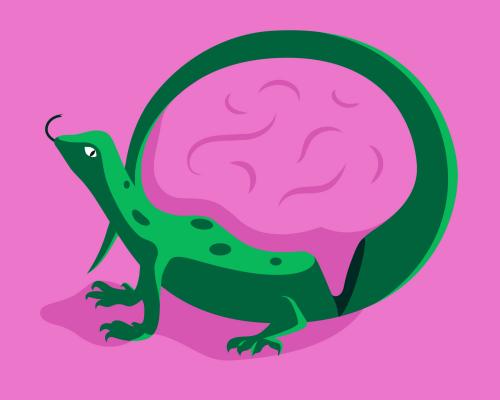
Humans have a cognitive quirk(怪癖;偏好) for the number three. Think of the many stories that use it, from The Three Little Pigs to Goldilocks and the Three Bears and The Three Musketeers. Public information and political campaigns use it for impact and ease of recall (“Stop, look and listen”; “See it. Say it. Sorted”; “Reduce, reuse, recycle”). And then there are psychological or philosophical frameworks: Freud with his id, ego and superego(弗洛伊德的三重人格结构); Plato’s three parts of the human soul; the Holy Trinity(基督教三位一体教义).
人类对数字“三”有一种认知上的偏好。想想多少故事都用到它:从《三只小猪》到《金发姑娘和三只熊》,再到《三个火枪手》。公共宣传和政治运动也利用“三”来增强冲击力、方便记忆(“停、看、听”;“看到它,说出来,搞定”;“减量化、再利用、再循环”)。此外还有心理学或哲学框架:弗洛伊德的本我、自我和超我;柏拉图关于人类灵魂的三重划分;基督教的三位一体。
Well, it turns out neuroscience isn’t immune from tri-mania(对“三”的狂热). In 1959 Paul D MacLean set out(提出;阐述) a new way of thinking about the evolution and function of the brain, which he christened(命名为) the “triune(三位一体的)” – three-in-one – model. It quickly became one of best known and most enduring(持久的) concepts in human biology. His idea was that a trio of distinct brains are layered inside our skulls, one on top of the other, all fighting to generate our feelings and thoughts.(他的观点是:三个截然不同的大脑层层叠叠地藏在我们颅骨内,一个压在另一个上面,彼此争夺,共同产生我们的感受和思想。)
好吧,事实证明神经科学也未能免于“三”的狂热。1959年,保罗·D·麦克莱恩提出了一种思考大脑进化与功能的新方式,他将其命名为“三位一体”(triune,即三合一)模型。该模型迅速成为人类生物学中最著名、最持久的概念之一。他的观点是:三个截然不同的大脑层层叠叠地藏在我们颅骨内,一个压在另一个上面,彼此争夺,共同产生我们的感受和思想。
Deep inside, at the centre, lurks the primitive lizard brain, retained from an ancestor we share with reptiles.(在深处、在中心,潜伏着原始的蜥蜴脑,它来自我们与爬行动物共有的祖先。) This contains ancient regions responsible for survival, helping us to hunt and forage(觅食), and driving our sexual impulses so that we reproduce. A second layer sits wrapped around the first, the so-called mammalian brain. It contains the limbic system(边缘系统), deemed(被认为) to be the seat of our emotions. It enabled mammals to play, care for and nurse their young and communicate in some crude(粗糙的;原始的) way.
在深处、在中心,潜伏着原始的蜥蜴脑,它来自我们与爬行动物共有的祖先。其中包含负责生存的古老脑区,帮助我们狩猎和觅食,并驱动性冲动以繁衍后代。第二层包裹着第一层,即所谓的哺乳动物脑。它包含边缘系统,被认为是情绪的所在。它使哺乳动物能够玩耍、照料和哺育幼崽,并以某种粗糙的方式交流。
Further reading
延伸阅读