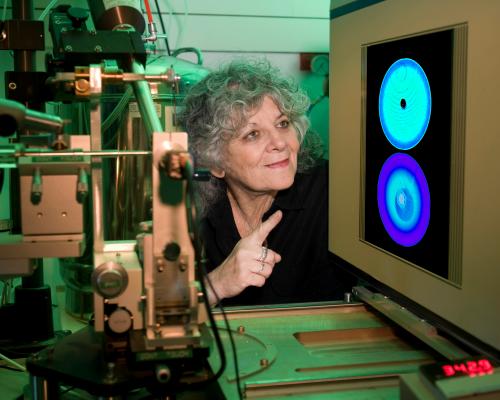
For years, the crystallographer(晶体学家) and biochemist Ada Yonath had to contend with(不得不应对) the disdain(蔑视) and sometimes derision(嘲笑) of many of her contemporaries after she set herself the challenge of(给自己定下……的挑战) mapping(绘制图谱) the molecular structure of the ribosome.
多年来,晶体学家和生物化学家阿达·约纳特在给自己定下绘制核糖体分子结构图谱的挑战后,不得不忍受许多同行的蔑视,有时甚至是嘲笑。
Ribosomes are found in all living cells. Effectively they are tiny factories that synthesise(合成) proteins, complex molecules that are vital for building and repairing the tissues and organs of animals and plants. Many scientists believed hers was a fruitless endeavour(徒劳的努力) because ribosomes are so small – sometimes only 20 nanometres(纳米) in diameter – irregular in shape and lacking internal symmetry(对称性). James Watson(DNA双螺旋发现者之一), one of the Nobel prizewinning discoverers of the double-helix structure of DNA, had tried and failed. But Yonath, who has died aged 87, proved her doubters wrong, and was rewarded with the 2009 Nobel prize in chemistry, only the fourth woman to receive it, which she shared with the biologist Venkatraman Ramakrishnan and biochemist Thomas Steitz.(但约纳特证明了质疑者的错误,获得了2009年诺贝尔化学奖,成为第四位获此奖的女性,与拉马克里希南和施泰茨共享。)
核糖体存在于所有活细胞中。它们实际上是合成蛋白质的微型工厂,而蛋白质是构建和修复动植物组织和器官所必需的复杂分子。许多科学家认为她的努力徒劳无功,因为核糖体太小——有时直径仅20纳米——形状不规则,且缺乏内部对称性。詹姆斯·沃森,诺贝尔奖得主、DNA双螺旋结构的发现者之一,曾尝试并失败了。但约纳特——她已于87岁去世——证明了质疑者的错误,并获得了2009年诺贝尔化学奖,成为第四位获此殊荣的女性,与生物学家文卡特拉曼·拉马克里希南和生物化学家托马斯·施泰茨共享该奖。
“I was met with disbelief(怀疑), even ridicule(嘲笑) in the international scientific community,” she said later. “I was called a dreamer, a fantasist(幻想家), even the village idiot(村中白痴). But when I succeeded, it created an overwhelming internal joy and those who once called me crazy or stupid became supporters.(但当我成功时,内心涌起巨大的喜悦,那些曾说我疯狂或愚蠢的人变成了支持者。)”
“国际科学界对我充满怀疑,甚至嘲笑,”她后来回忆道。“我被叫做梦想家、幻想家,甚至村中白痴。但当我成功时,内心涌起巨大的喜悦,那些曾说我疯狂或愚蠢的人变成了支持者。”