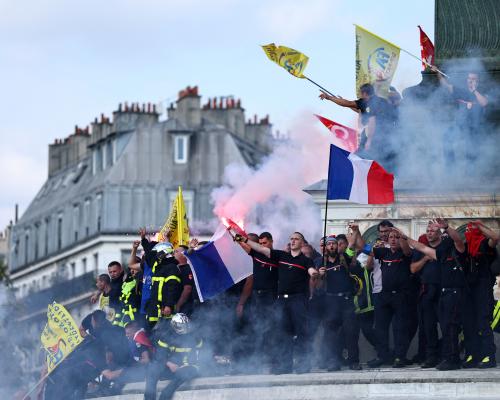
Eight years have passed since rising fuel prices brought the gilets jaunes (yellow vest) demonstrators to the streets of France, prompting the first big crisis of Emmanuel Macron’s time in the Élysée Palace.(八年前,燃油价格上涨将“黄马甲”抗议者带上法国街头,引发了马克龙入主爱丽舍宫以来的首次重大危机。)
八年前,燃油价格上涨将“黄马甲”抗议者带上法国街头,引发了埃马纽埃尔·马克龙入主爱丽舍宫以来的首次重大危机。
As the French president contemplates his exit next year, turmoil has again gripped the streets in the form of student protests, but this time the financial markets are unhappy too.(当法国总统盘算着明年卸任之际,动荡再次以学生抗议的形式席卷街头,但这一次,金融市场也感到不满。)
当法国总统盘算着明年卸任之际,动荡再次以学生抗议的形式席卷街头,但这一次,金融市场也感到不满。
Investors are concerned about the government’s failure to bring spending under control and end a long period of “fiscal incontinence(财政失禁,指无节制支出)”. Financial markets are unnerved(使不安,使紧张) by similar trends in the UK, the US and more recently Italy, causing jitters(紧张不安,恐慌) in global bond markets. But it’s France that has become the biggest worry, hemmed in by debts across the public and private sectors, limiting their scope to dig the country out of a deepening hole.(但法国已成为最大的担忧,公共和私营部门的债务使其腹背受敌,限制了它们帮助国家摆脱日益加深的困境的空间。)
投资者担心政府未能控制支出、结束长期的“财政失禁”。英国、美国以及最近意大利的类似趋势也让金融市场感到不安,引发全球债券市场震荡。但法国已成为最大的担忧,公共和私营部门的债务使其腹背受敌,限制了它们帮助国家摆脱日益加深的困境的空间。
‘I am panicking’
“我感到恐慌”
Political turmoil
政治动荡
‘Too big to save’
“大到救不起”