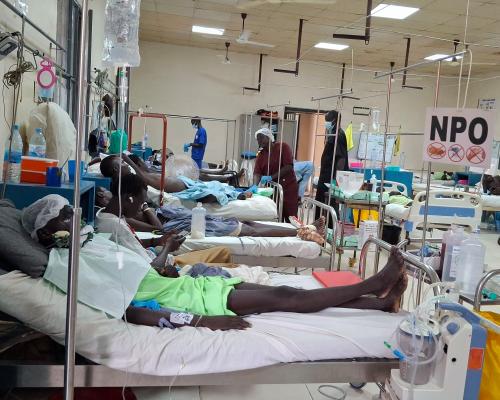
By 11am on a recent Thursday, Dr Slobodan Mirosavljev had already seen two critically(危重地) wounded patients at Juba military hospital. The day was barely halfway through, but the surgeon couldn’t say how long he would be at the facility(医疗机构).
最近一个周四,上午11点,斯洛博丹·米罗萨夫列夫医生已经在朱巴军事医院接诊了两名危重伤员。一天才过了一半,但这位外科医生说不准自己还要在医院待多久。
A patient shot in the abdomen(腹部), head or chest could arrive without warning(毫无预兆地). A helicopter could bring several critically wounded people from another part of South Sudan. A mass casualty incident(大规模伤亡事件) could fill the wards within hours.
腹部、头部或胸部中弹的伤员可能毫无预兆地到来。一架直升机可能从南苏丹其他地方送来多名危重伤员。一场大规模伤亡事件可能在几小时内就填满病房。
For Mirosavljev and his colleagues, uncertainty has become part of the job at the hospital, where the International Committee of the Red Cross (ICRC) supports surgeries for weapon-wounded victims of renewed fighting between the military, known as the South Sudan People’s Defence Forces (SSPDF), and the Sudan People’s Liberation Movement-In Opposition (SPLM-IO), which is loyal to former vice-president Riek Machar, and allied groups.(对米罗萨夫列夫和他的同事来说,不确定性已成为这家医院工作的一部分。国际红十字委员会在这里为武器致伤的受害者提供手术支持,这些伤者来自军队与反对派及其盟军之间重新爆发的战斗。)
对米罗萨夫列夫和他的同事来说,不确定性已成为这家医院工作的一部分。国际红十字委员会(ICRC)在这里为武器致伤的受害者提供手术支持,这些伤者来自军队——即南苏丹人民国防军(SSPDF)——与效忠前副总统里克·马沙尔的苏丹人民解放运动反对派(SPLM-IO)及其盟军之间重新爆发的战斗。