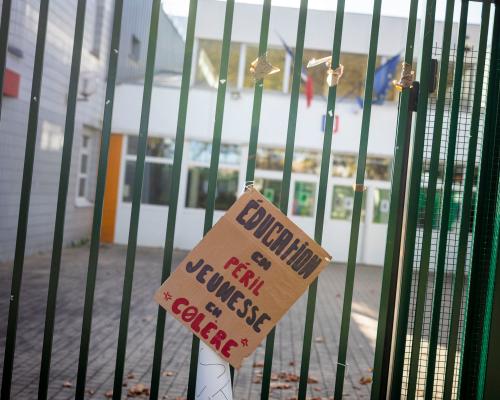
On a normal school day, Mohammed, 17, wakes at 6am, cares for his younger siblings(兄弟姐妹) to help his single mother(单亲母亲) who works as a security guard, then takes two crowded buses and a local train to get to his high school in Sevran, a low-income banlieue((法语)郊区,特指问题较多的移民聚居区) town in the suburbs north-east of Paris.
在一个平常的上学日,17岁的穆罕默德早上6点起床,帮助做保安的单身母亲照顾弟弟妹妹,然后乘坐两趟拥挤的公交车和一列郊区火车,前往塞夫朗的高中。塞夫朗是巴黎东北郊一个低收入郊区小镇。
“There aren’t enough chairs or desks to go round(足够分配), so some students have to stand up,” Mohammed said. “Classes can be so packed(拥挤的) you can’t interact with the teacher. In this year’s heatwaves(热浪), it felt like 40 degrees in overcrowded(过度拥挤的) classrooms with no shade or curtains. It was so hot my brain couldn’t function.(天太热了,我的大脑都无法运转。)”
“椅子或桌子不够分,所以有些学生只能站着上课,”穆罕默德说。“班级太拥挤,你根本无法与老师互动。今年的热浪期间,拥挤的教室里没有遮阳或窗帘,感觉像有40度。热得我脑子都无法运转。”
The 17-year-old in his last year of high school wants to study management and digital communication(数字传播) at a Paris university. But he said conditions were so poor, he felt all odds were stacked against(一切都不利于……) him and his classmates.
这位17岁的高三学生想在巴黎的大学学习管理和数字传播。但他说,条件太差,他感觉一切都不利于他和同学们。