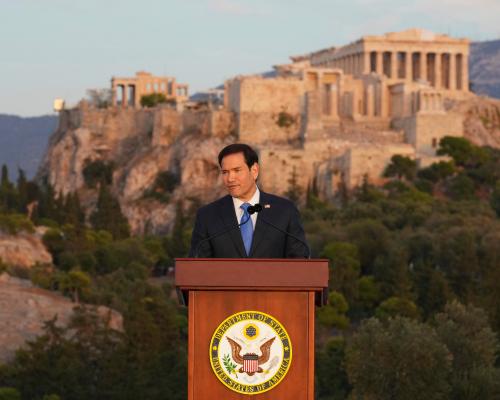
They had obviously worked hard on the backdrop(背景) – and it was magnificent(壮丽的). On 7 October, the US secretary of state, Marco Rubio, delivered a major speech in Athens, outdoors, with the Acropolis behind him. The sun was setting, bathing the ancient scene, including the Parthenon, in the light of the golden hour(金色时刻).
他们显然在背景布置上下了很大功夫——而且效果壮丽。10月7日,美国国务卿马可·鲁比奥在雅典发表了一场重要演讲,地点在户外,身后就是卫城。夕阳西下,金色时刻的光芒洒在这片古老景象上,包括帕特农神庙。
The golden hour, but yet not quite the golden age(黄金时代). This was not Pericles(伯里克利) defending democracy. Instead, Rubio offered a haunting vision of the choices facing the west, arguing that the US and Europe must rediscover the values of exploration and conquest that once drove centuries of expansion, or face decline and irrelevance.(相反,鲁比奥描绘了一幅萦绕不去的西方抉择图景,声称美欧必须重新发现曾驱动数百年扩张的探索与征服价值观,否则就将面临衰落与边缘化。)
金色时刻,却算不上黄金时代。这不是伯里克利在捍卫民主。相反,鲁比奥描绘了一幅萦绕不去的西方抉择图景,声称美欧必须重新发现曾驱动数百年扩张的探索与征服价值观,否则就将面临衰落与边缘化。
For long stretches, it was an exercise in nostalgia(怀旧之举), lament(哀叹)ing the decline of western civilization as if this were a seminar at Hillsdale College or the Claremont Institute.
演讲大部分时间都在怀旧,哀叹西方文明的衰落,仿佛这是希尔斯代尔学院或克莱蒙特研究所的一场研讨会。