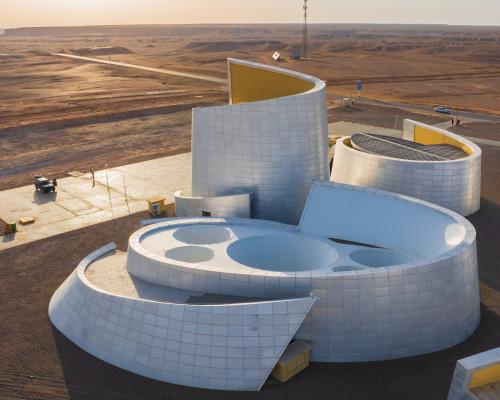
Viewed from afar, the silver-hued(银色的) Hami Pterosaur Museum almost looks like a space base on Mars. Viewed from above, it resembles a collection of(一批、一组) dinosaur eggs in the sand. Nestled in the Gobi desert, in north-west China, the new tourist attraction showcases hundreds of impressive fossils of pterosaurs(翼龙), ancient flying reptiles related to dinosaurs. But far from reflecting its prehistoric exhibits, the building itself is a modern-day architectural specimen.(然而,这座建筑本身并非映照史前展品,而是一件现代建筑标本。)
从远处看,银色的哈密翼龙博物馆几乎像火星上的太空基地。从上方俯瞰,它又像沙地里的一窝恐龙蛋。这座新旅游景点坐落于中国西北的戈壁沙漠,展出数百件令人惊叹的翼龙化石——翼龙是远古会飞的爬行动物,与恐龙有亲缘关系。然而,这座建筑本身并非映照史前展品,而是一件现代建筑标本。
Designed with underground exhibition halls, giant light funnels(漏斗) and sprawling(广阔的、蔓延的) solar farms, the museum is able to operate sustainably while withstand(抵御、承受)ing an extremely harsh environment.
博物馆设有地下展厅、巨型采光漏斗和广阔的太阳能农场,因此能够可持续运营,同时抵御极端严酷的环境。
The Hami region is notorious(臭名昭著的、以……闻名) for its scorching(酷热的) summers. Air temperatures can exceed 55C (131F), while the surface ground temperature can reach 80C, says Wang Xiaolin, the director of the museum and a palaeontologist(古生物学家) at the Chinese Academy of Sciences. Violent winds and sandstorms terrorise the area frequently, according to Xiaolin, who has carried out excavation work in Hami for 20 years.(据汪筱林介绍,狂风和沙尘暴频繁肆虐该地区。他在哈密从事发掘工作已有20年。)
哈密地区以酷热的夏季而闻名。博物馆馆长、中国科学院古生物学家汪筱林表示,当地气温可超过55摄氏度(131华氏度),而地表温度可达80摄氏度。据汪筱林介绍,狂风和沙尘暴频繁肆虐该地区。他在哈密从事发掘工作已有20年。