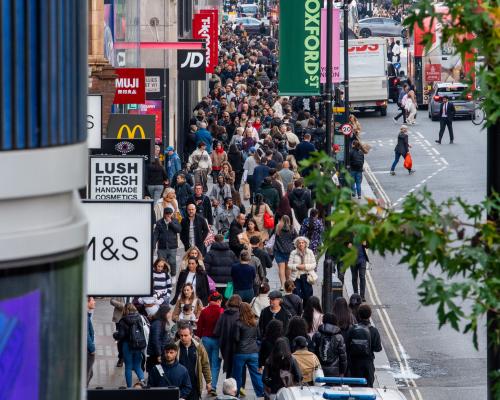
In February, the mayor of London, Sadiq Khan, announced that Britain’s best-known thoroughfare(大道,要道), Oxford Street, would be pedestrianise(使步行化)d. To the surprise of every Londoner that I have spoken to in the past few months, it is actually happening. On Monday 26 October, the busiest shopping street in Europe – or, precisely, half of its 1.2-mile stretch – will be closed to traffic, putting an end to several decades of bitter arguments, obstructions and delays.(10月26日星期一,欧洲最繁忙的购物街——准确地说,是其1.2英里路段的一半——将禁止车辆通行,从而结束数十年来激烈的争吵、阻挠和拖延。) Cars, lorries, vans, taxis, buses, bicycles, ebikes, scooters will be banned. Nothing but pedestrians (and emergency vehicles) will be allowed in.
今年二月,伦敦市长萨迪克·汗宣布,英国最著名的街道牛津街将实行步行化。过去几个月我交谈过的每一位伦敦人都感到惊讶——它居然真的要实现了。10月26日星期一,欧洲最繁忙的购物街——准确地说,是其1.2英里路段的一半——将禁止车辆通行,从而结束数十年来激烈的争吵、阻挠和拖延。汽车、卡车、货车、出租车、公交车、自行车、电动自行车、踏板车都将被禁止。除了行人(和紧急车辆),任何车辆都不得进入。
This change will mark the most remarkable transformation to the streetscape(街景) of central London since at least 2003, when Trafalgar Square was turned from a glorified roundabout(美其名曰的环岛) into one of London’s most recognisable public spaces. It will also form the most visible part of the mayor’s legacy(遗产,政治遗产), whether or not Khan runs for a fourth term in 2028. Three years ago, Khan published a memoir(回忆录) and manifesto(宣言), Breathe, attributing his asthma(哮喘) to growing up inhaling London’s polluted air. For the mayor, pedestrianising Oxford Street is the culmination(顶峰,高潮) of a mission to create a greener city that is oriented around(以……为导向) public health, walking and cycling.
这一变化将标志着至少自2003年以来伦敦市中心街景最引人注目的改造——那一年,特拉法加广场从一个美其名曰的环岛变成了伦敦最具辨识度的公共空间之一。无论汗是否在2028年竞选第四个任期,这都将成为他政治遗产中最显眼的部分。三年前,汗出版了一本回忆录兼宣言《呼吸》,将自己的哮喘归咎于在伦敦污染空气中长大。对这位市长而言,牛津街步行化是一项使命的顶峰——打造一座更绿色、以公共卫生、步行和骑行导向的城市。
Pedestrianisation is one thing; making Oxford Street somewhere anyone actually wants to spend time is another. For weary(疲惫的) Londoners and anxious visitors alike(两者都), it is a headache in the form of a high street. Its primary associations are crowds, stress, dirt, noise, the tackiest incarnation(化身,表现形式)s of consumer capitalism, and crime. At one point during my research I approached a harried(焦头烂额的) police officer in the throng(人群) outside Tottenham Court Road tube station and asked if she thought pedestrianisation would be good for Oxford Street, or make her job harder. Both, she said.
步行化是一回事;让牛津街变成人们真正愿意待的地方是另一回事。对疲惫的伦敦人和焦虑的游客来说,它都是一条令人头疼的商业街。人们想到它,首先联想到的是人群、压力、脏乱、噪音、消费资本主义最俗气的化身,以及犯罪。在我调研期间,有一次我在托特纳姆法院路地铁站外的人群中走向一位忙得焦头烂额的警察,问她步行化对牛津街是好事,还是会让她的工作更难。她说,两者都有。